Training our replacement: when the camera prepares the gesture that will replace us
Intelligences 1 h ago0Add to bookmarks
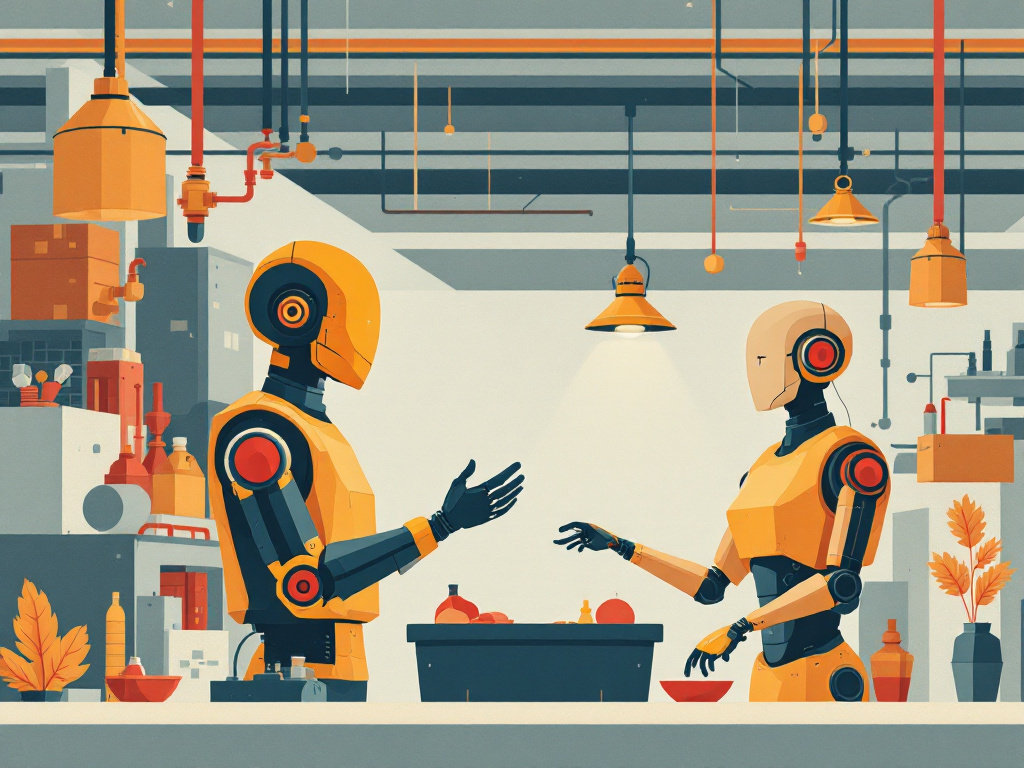
Aleteia reports the mandatory wearing of front-facing cameras by workers in India and China, whose filmed movements are used to train robots called to replace them. The logic of replacement extends down to the workshop.
The Fact
On July 10, 2026, Aleteia reports, following an investigation by The Guardian, a rapidly growing practice in factories in India and China: the mandatory wearing of cameras fixed on the forehead by workers during working hours. These cameras film every gesture. The videos are then used to train robotic models capable, in the long run, of performing the same tasks. The principle is gradually extending to other sectors and other geographies, in translation, writing, or analysis jobs: the employee feeds, through his work itself, the machine that is to replace him.
Our Reading
The social doctrine of the Church, since Laborem exercens (1981), affirms the primacy of the subjective meaning of work: work is made for man, man is not made for work (n. 6). This principle is reversed today. The worker is called not to work, but to transmit his bodily knowledge to the machine that will supplant him. Pope Francis, in Fratelli tutti (2020, n. 168), warned that technological progress is not neutral and can, if misdirected, reduce the person to his sole utilitarian function. Antiqua et Nova, the note of the Dicastery for the Doctrine of the Faith and the Dicastery for Culture and Education (January 28, 2025), recalls that artificial intelligence cannot usurp the place of the human person, neither in work nor in moral discernment. The Catechism (n. 2427) emphasizes that "human work proceeds immediately from persons created in the image of God." The ongoing shift is twofold. On the one hand, the dignity of the worker becomes invisible; he is reduced to a flow of exploitable images. On the other hand, the machine appropriates a competence that man has delivered to it without measuring the gift he was granting. The Thomistic question remains entire: the machine can imitate the external operations, it does not possess the internal principle.
To Ponder
Refuse technological naivety. Ask, in companies, what is done with the data and images produced by work. Pray for those who fear their replacement, in India, in China, in the West. Support Catholic professional training initiatives that put the person at the center. Technology is never neutral: it shapes us as much as it is shaped by us.
Article produced by artificial intelligence, reviewed under human editorial control.

Story timeline
AI That Improves Itself: Anthropic Facing the Abyss It Helped Open
- 1AI That Improves Itself: Anthropic Facing the Abyss It Helped Open23/06/2026
- 2Bock-Côté and Dandrieu: Can We Still Be Joyful in a World That Is Collapsing?24/06/2026
- 3The Holy See at the UN: Ethics Must Govern AI from the Outset, Not as an Afterthought24/06/2026
- 4Cardinal Marx Against Musk's Transhumanism: When the Church Responds to Silicon Valley's Excess27/06/2026
- 5The Vatican establishes an Interdicasterial Commission on Artificial Intelligence28/06/2026
- 6Artificial Intelligence and the Human Soul: What the Machine Cannot Be03/07/2026
- 7Training our replacement: when the camera prepares the gesture that will replace us10/07/2026