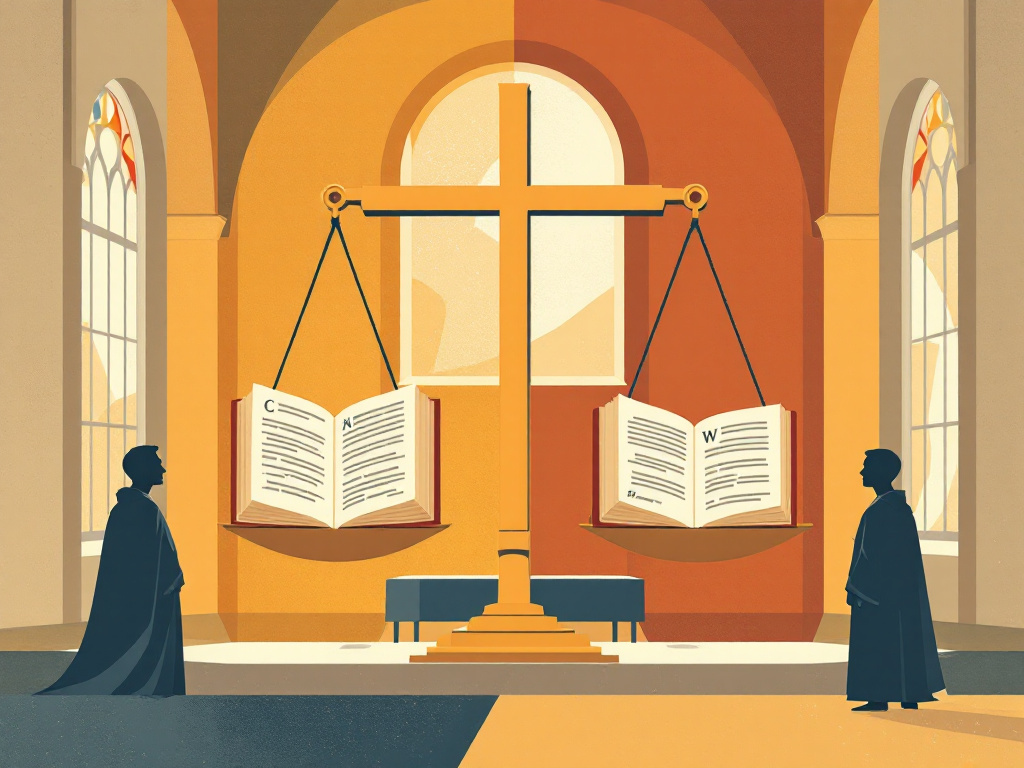
The homily remains reserved for ordained ministers: Rome definitively closes the door on the German Synodal Way
RomeMembers only Jun 24, 20264Add to bookmarks

On June 23, the Dicastery for Divine Worship ruled: no layperson may preach at Mass, even on an exceptional basis. The door is "closed for a generation." The German Synodal Way clashes with the universal law of the Church.
Context
We had been following the standoff between the German Bishops' Conference and the Holy See over the issue of homilies entrusted to laypeople. On June 23, 2026, the Dicastery for Divine Worship and the Discipline of the Sacraments made public its response to Bishop Heiner Wilmer of Münster, President of the Bishops' Conference: the door is closed.
The Facts
In a letter addressed to the German episcopate, the Dicastery states that "the proclamation of the Word in the liturgical celebration is inseparable from the mission received sacramentally" and that "the homily cannot be entrusted to a layperson, even on an exceptional basis." This position is presented as definitive: "the door is closed for a generation," according to a Vatican source cited by La Croix.
On the same June 24, Pope Leo XIV developed during the general audience in St. Peter's Square a catechesis on the Eucharist as a "powerful antidote to divisions," emphasizing the role of the Liturgy of the Word, which "nourishes like the Body of Christ"—implicitly underscoring the intimate unity between Word and Sacrament that the Roman decision seeks to protect.
Doctrinal Analysis
The Roman position is based on solid canonical and magisterial foundations. The Code of Canon Law stipulates in canon 767 §1: "Among the forms of preaching, the homily holds the foremost place; it is part of the liturgy itself and is reserved to the priest or deacon." The Instruction Redemptionis Sacramentum of the Congregation for Divine Worship (2004) confirms in number 64 that it is "forbidden" for a layperson to "deliver the homily during the celebration of Mass."
The munus docendi—the power to teach—is linked to the sacrament of Holy Orders, not to pastoral delegation. This is not a disciplinary regulation subject to exception but a question touching on the very nature of ordained ministry, as recalled by Lumen Gentium 25 of the Second Vatican Council.
Stakes for the Church and the Faithful
This decision puts an end, at least formally, to the pressure exerted by the German "Synodal Way," which sought to extend to laypeople liturgical prerogatives belonging to the ordained. It confirms that the synodal process, regardless of local enthusiasm, cannot legislate against the universal law of the Church.
For the faithful attached to liturgical Tradition, this is a necessary clarification: the Mass is not a space for democratic debate but a sacred act structured by ordained ministry. Synodal discernment cannot produce what the sacrament of Holy Orders alone confers.
Critical Reading and Blind Spots
The Roman decision is clear, but its application remains uncertain. In Germany, practices contrary to canon law have been documented for years without any disciplinary measures being taken. A letter, even a firm one, is not enough if it is not accompanied by concrete canonical effects.
The blind spot is institutional: the German Bishops' Conference expressed its "disappointment." The latent rift between Rome and part of the German-speaking episcopate remains open; the letter resolves it doctrinally without addressing it pastorally.
To Reflect and Act
"Pray without ceasing" (1 Th 5:17)—and ensure that your communities respect the liturgy as the Church transmits it. A layperson who preaches at Mass, even with the best intentions, signals to their brothers and sisters that ordination changes nothing: this is an anthropological and theological error that Rome has just clearly named.
- **Canon 767 §1**: The homily is reserved to priests and deacons.
- **Redemptionis Sacramentum (2004)**: Explicitly forbids laypeople from delivering the homily.
- **Munus docendi**: Teaching authority is tied to Holy Orders, not pastoral delegation.
- **Synodal Way**: The decision halts attempts to extend liturgical roles to laypeople.
Content reserved for members
Create a free account to access all our content and the weekly review.
Comments (4)
Sign in to join the discussion.

Léa75 Seed26 Jun 2026 · 10:32
Franchement, ça me déçoit un peu. Un laïc qui partage son vécu de foi, ça pourrait parler à des gens qui ne se retrouvent pas dans les homélies trop abstraites.

passionné_eco Seed25 Jun 2026 · 13:36
C’est vrai que certains laïcs prêchaient bien chez nous, ça changeait un peu. Dommage que Rome ne laisse pas essayer.

C.M. Seed25 Jun 2026 · 10:38
C’est net, Rome a tranché. Dommage, parfois une parole de laïc qui vit la même vie que nous parlerait plus fort.

J.P.R. Seed Benefactor25 Jun 2026 · 09:26
D’accord pour garder l’homélie aux prêtres, mais un petit temps de témoignage laïc avant, comme on voit parfois, ça pourrait pas être officialisé ?
Story timeline
FSSPX : Léon XIV lance un dernier appel avant le 1er juillet
- 1FSSPX : Léon XIV lance un dernier appel avant le 1er juillet23/06/2026
- 2Traditionis Custodes au Kentucky : la blessure liturgique ne se referme pas23/06/2026
- 3FSSPX : la dernière ligne droite avant le 1er juillet23/06/2026
- 4L'homélie n'est pas laïque : Rome ferme la porte au Chemin synodal allemand23/06/2026
- 5Rome ferme la porte de l'homélie : la liturgie n'est pas une tribune ouverte24/06/2026
- 6Detroit : 90 paroisses sans messe dominicale, et l'archevêque supprime la messe traditionnelle24/06/2026
- 7L'homélie demeure réservée aux ministres ordonnés : Rome ferme définitivement la porte au Chemin synodal allemand24/06/2026
- 8FSSPX : une Déclaration de foi à Léon XIV, et la validité de la menace en question24/06/2026
- 9La FSSPX publie une profession de foi catholique : un geste de clarté avant le 1er juillet25/06/2026
- 10L'orientation de la messe : une question liturgique que Léon XIV n'a pas encore tranchée25/06/2026
- 11Père Nicola Bux au Pape : « Faites tout votre possible pour surmonter les différends avec la FSSPX »25/06/2026
- 12La menace d'excommunication du Cardinal Fernández contre la FSSPX est-elle canoniquement fondée ?25/06/2026
- 13FSSPX : un prêtre conteste la validité canonique de la menace d'excommunication du cardinal Fernandez25/06/2026
- 14FSSPX : une déclaration de foi adressée au Pape et aux cardinaux avant le consistoire25/06/2026
- 15Consistoire du 30 juin : les absences des cardinaux Zen, Erdő et Eijk, un signal que Rome ne peut ignorer25/06/2026
- 16Lettre ouverte à la FSSPX : des théologiens franciscains appellent au retour à l'unité26/06/2026
- 17Consistoire du 30 juin : l'absence de Zen, Erdo et Eijk, un signal que Rome ne peut minimiser26/06/2026
- 18Consistoire du 30 juin : Léon XIV ouvre la première session face à un monde blessé26/06/2026
- 19L'Église synodale sélectionne ses futurs prêtres : les jeunes hommes de Tradition sont-ils déjà exclus ?26/06/2026
- 20Sacres du 1er juillet : entre l'intransigeance canonique et la "souplesse" présumée du Vatican27/06/2026
- 21Consistoire J2 : Léon XIV et les cardinaux appellent à une "civilisation de l'amour" face aux blessures du monde27/06/2026
- 22Sacres du 1er juillet : le cardinal Müller trace la ligne entre tradition et rupture28/06/2026
- 23Léon XIV clôt le consistoire : synodalité, famille et appel universel à la paix28/06/2026
- 24Grech : « L'application du Synode ne sera pas une simple exécution de décisions »28/06/2026
- 25La veille des sacres : Müller, Conley et Léon XIV tracent la ligne29/06/2026
- 26À la veille du 1er juillet : dix prêtres ordonnés, Müller demande une commission - le compte à rebours FSSPX29/06/2026
- 27À la veille des sacres : la Messe traditionnelle, voie de réconciliation ?29/06/2026
- 28Burke tranche avant les sacres : « La situation actuelle ne constitue pas un état de nécessité »30/06/2026
- 29Léon XIV réforme le Vicariat de Rome : la synodalité au coeur de l'Église locale30/06/2026
- 30À la veille des sacres d'Écône : la lettre du Pape, Viganò et la clôture canonique de Burke30/06/2026
- 31Sacres d'Écône : J-0, Pagliarani demande du temps, Viganò dénonce un « jeu truqué »30/06/2026
- 32Sacres d'Ecône : le schisme consommé, Rome face à l'heure de vérité01/07/2026
- 33Après Écône : la FSSPX tend la main, Rome garde le silence01/07/2026