Rome closes the door on homilies: liturgy is not an open forum
RomeMembers only Jun 24, 20261Add to bookmarks
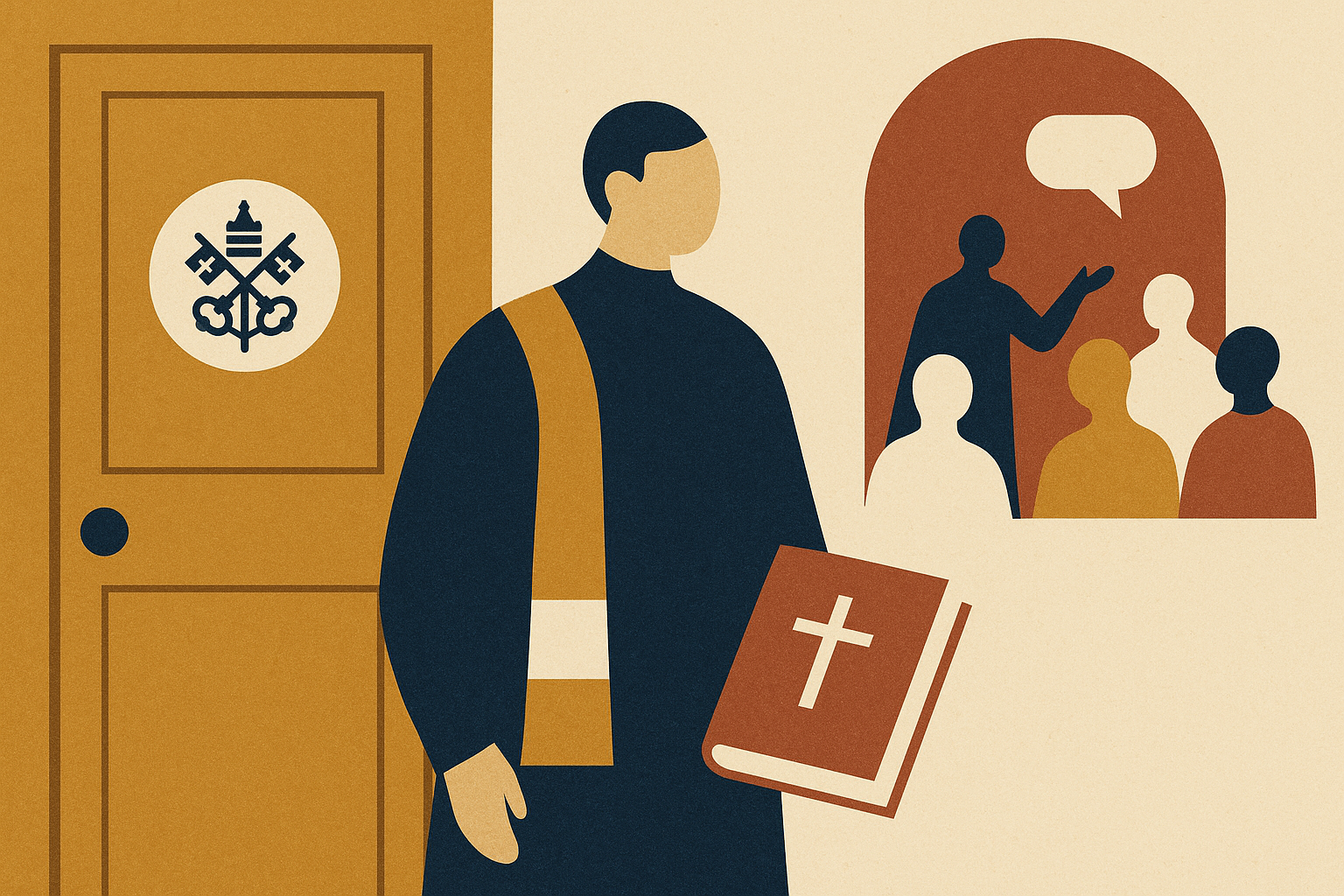
The Dicastery for Divine Worship responded on June 23, 2026, to German bishops who had requested to open the homily to laypeople: no. The door is closed. Abbé Grégoire Masson analyzes the theological significance of this refusal, which is not a policy, but a doctrine.
Context
We had followed the confrontation between the German Synodal Path and Rome on the issue of lay homilies. In March 2026, Bishop Heiner Wilmer, President of the German Bishops' Conference, had formally requested the Dicastery for Divine Worship and the Discipline of the Sacraments to authorize laypeople to preach during Mass. The response came on June 23, 2026. It is clear.
The Facts
In a letter made public on June 23, 2026, the Dicastery for Divine Worship and the Discipline of the Sacraments refused the requested authorization. According to a Vatican source cited by La Croix, "the door is closed for a generation." Le Salon Beige published the following day, June 24, a doctrinal excerpt from the letter itself: "The homily constitutes an integral part of the liturgy; it is intrinsically linked to the proclamation of the Gospel and represents an exercise of the munus docendi—the power to teach—entrusted to ordained ministers by the sacrament of Holy Orders."
The formulation is precise and deliberate. It does not rely on revisable disciplinary norms but on the sacramental nature of the ordained ministry.
Doctrinal Analysis
The homily is not a lecture inserted into the Mass. According to the Second Vatican Council, it is "part of the liturgy itself" (Sacrosanctum Concilium, n. 52). This liturgical integration explains why it cannot be entrusted to a layperson: this is not a question of intellectual competence or spiritual quality but of sacramental configuration.
The Code of Canon Law is explicit: "The homily, which is part of the liturgy itself and is reserved to the priest or deacon, is to be delivered" (CIC, can. 767, § 1). This reservation is not an old custom: it is the universal law of the Church, founded on the theology of the ministerial priesthood.
The munus docendi—the duty to teach—is one of the three functions (tria munera) received by the bishop and shared with the priest in the exercise of ministry: to teach, to sanctify, to govern. Entrusting the homily to a layperson would not be a delegation of competence: it would be the confusion of two states in the Church that Lumen Gentium carefully distinguishes: the ministerial priesthood and the common priesthood of the faithful, "which differ essentially and not only in degree" (Lumen Gentium, n. 10).
Stakes for the Church and the Faithful
The German request is part of a broader logic of the Synodal Path (Synodalweg): aligning ecclesial structures with Protestant practices by granting laypeople functions symbolically reserved for ordained ministers. Rome has already refused the ordination of women, the blessing of homosexual couples in a context that would simulate a sacramental rite, and now lay homilies.
This is not an excess of centralism. It is the role of the Magisterium: to safeguard the deposit of faith against developments that, under the guise of pastoral updating, alter doctrinal substance. The problem of the German Church is not a lack of participatory structures. It is first and foremost a crisis of faith, measured by the collapse of religious practice, which no institutional reform can resolve.
For the faithful attached to the liturgy, this refusal is a confirmation: the Mass is not a civic assembly where roles are distributed according to sociology. It is the action of Christ the Priest, made present through the ordained ministry.
Critical Reading and Blind Spots
It would be naive to believe that this refusal closes the debate in Germany. The Bishops' Conference has not abandoned its synodal process. Some dioceses have already experimented de facto with lay interventions during Mass under alternative formulations ("homiletic sharing," "communal meditation"). Rome will have to monitor these workarounds.
The phrase "closed for a generation" also deserves critical scrutiny: it suggests the question could be reopened in twenty or thirty years. That is not what doctrine states. It may be what some Roman circles want to hear to ease a way out of the crisis. The distinction between revisable discipline and immutable doctrine remains the underlying issue.
To Reflect and Act
Pope Leo XIV, recently questioned about Vatican II, recalled that the Council must be read in continuity with the Magisterium, not as a rupture. The Dicastery's decision aligns with this principle. It invites every Catholic to rediscover what the Mass truly means: not a self-celebrating assembly, but God's action in the flesh of His Church.
The homily, which is part of the liturgy itself and is reserved to the priest or deacon, is to be delivered at all Masses on Sundays and holy days of obligation celebrated with a congregation.
Content reserved for members
Create a free account to access all our content and the weekly review.
Comments (1)
Sign in to join the discussion.

sophie.b 24 Jun 2026 · 13:18
C'est vrai que certains laïcs pourraient apporter un éclairage utile, mais bon, si Rome dit non, c'est que ça doit toucher à quelque chose d'important dans la messe.
Story timeline
FSSPX : Léon XIV lance un dernier appel avant le 1er juillet
- 1FSSPX : Léon XIV lance un dernier appel avant le 1er juillet23/06/2026
- 2Traditionis Custodes au Kentucky : la blessure liturgique ne se referme pas23/06/2026
- 3FSSPX : la dernière ligne droite avant le 1er juillet23/06/2026
- 4L'homélie n'est pas laïque : Rome ferme la porte au Chemin synodal allemand23/06/2026
- 5Rome ferme la porte de l'homélie : la liturgie n'est pas une tribune ouverte24/06/2026
- 6Detroit : 90 paroisses sans messe dominicale, et l'archevêque supprime la messe traditionnelle24/06/2026
- 7L'homélie demeure réservée aux ministres ordonnés : Rome ferme définitivement la porte au Chemin synodal allemand24/06/2026
- 8FSSPX : une Déclaration de foi à Léon XIV, et la validité de la menace en question24/06/2026
- 9La FSSPX publie une profession de foi catholique : un geste de clarté avant le 1er juillet25/06/2026
- 10L'orientation de la messe : une question liturgique que Léon XIV n'a pas encore tranchée25/06/2026
- 11Père Nicola Bux au Pape : « Faites tout votre possible pour surmonter les différends avec la FSSPX »25/06/2026
- 12La menace d'excommunication du Cardinal Fernández contre la FSSPX est-elle canoniquement fondée ?25/06/2026
- 13FSSPX : un prêtre conteste la validité canonique de la menace d'excommunication du cardinal Fernandez25/06/2026
- 14FSSPX : une déclaration de foi adressée au Pape et aux cardinaux avant le consistoire25/06/2026
- 15Consistoire du 30 juin : les absences des cardinaux Zen, Erdő et Eijk, un signal que Rome ne peut ignorer25/06/2026
- 16Lettre ouverte à la FSSPX : des théologiens franciscains appellent au retour à l'unité26/06/2026
- 17Consistoire du 30 juin : l'absence de Zen, Erdo et Eijk, un signal que Rome ne peut minimiser26/06/2026
- 18Consistoire du 30 juin : Léon XIV ouvre la première session face à un monde blessé26/06/2026
- 19L'Église synodale sélectionne ses futurs prêtres : les jeunes hommes de Tradition sont-ils déjà exclus ?26/06/2026
- 20Sacres du 1er juillet : entre l'intransigeance canonique et la "souplesse" présumée du Vatican27/06/2026
- 21Consistoire J2 : Léon XIV et les cardinaux appellent à une "civilisation de l'amour" face aux blessures du monde27/06/2026
- 22Sacres du 1er juillet : le cardinal Müller trace la ligne entre tradition et rupture28/06/2026
- 23Léon XIV clôt le consistoire : synodalité, famille et appel universel à la paix28/06/2026
- 24Grech : « L'application du Synode ne sera pas une simple exécution de décisions »28/06/2026
- 25La veille des sacres : Müller, Conley et Léon XIV tracent la ligne29/06/2026
- 26À la veille du 1er juillet : dix prêtres ordonnés, Müller demande une commission - le compte à rebours FSSPX29/06/2026
- 27À la veille des sacres : la Messe traditionnelle, voie de réconciliation ?29/06/2026
- 28Burke tranche avant les sacres : « La situation actuelle ne constitue pas un état de nécessité »30/06/2026
- 29Léon XIV réforme le Vicariat de Rome : la synodalité au coeur de l'Église locale30/06/2026
- 30À la veille des sacres d'Écône : la lettre du Pape, Viganò et la clôture canonique de Burke30/06/2026
- 31Sacres d'Écône : J-0, Pagliarani demande du temps, Viganò dénonce un « jeu truqué »30/06/2026
- 32Sacres d'Ecône : le schisme consommé, Rome face à l'heure de vérité01/07/2026
- 33Après Écône : la FSSPX tend la main, Rome garde le silence01/07/2026