Michael Caine Sells His Voice: When Man Rents to Machine What Defines Him
Intelligences Jun 24, 20263Add to bookmarks
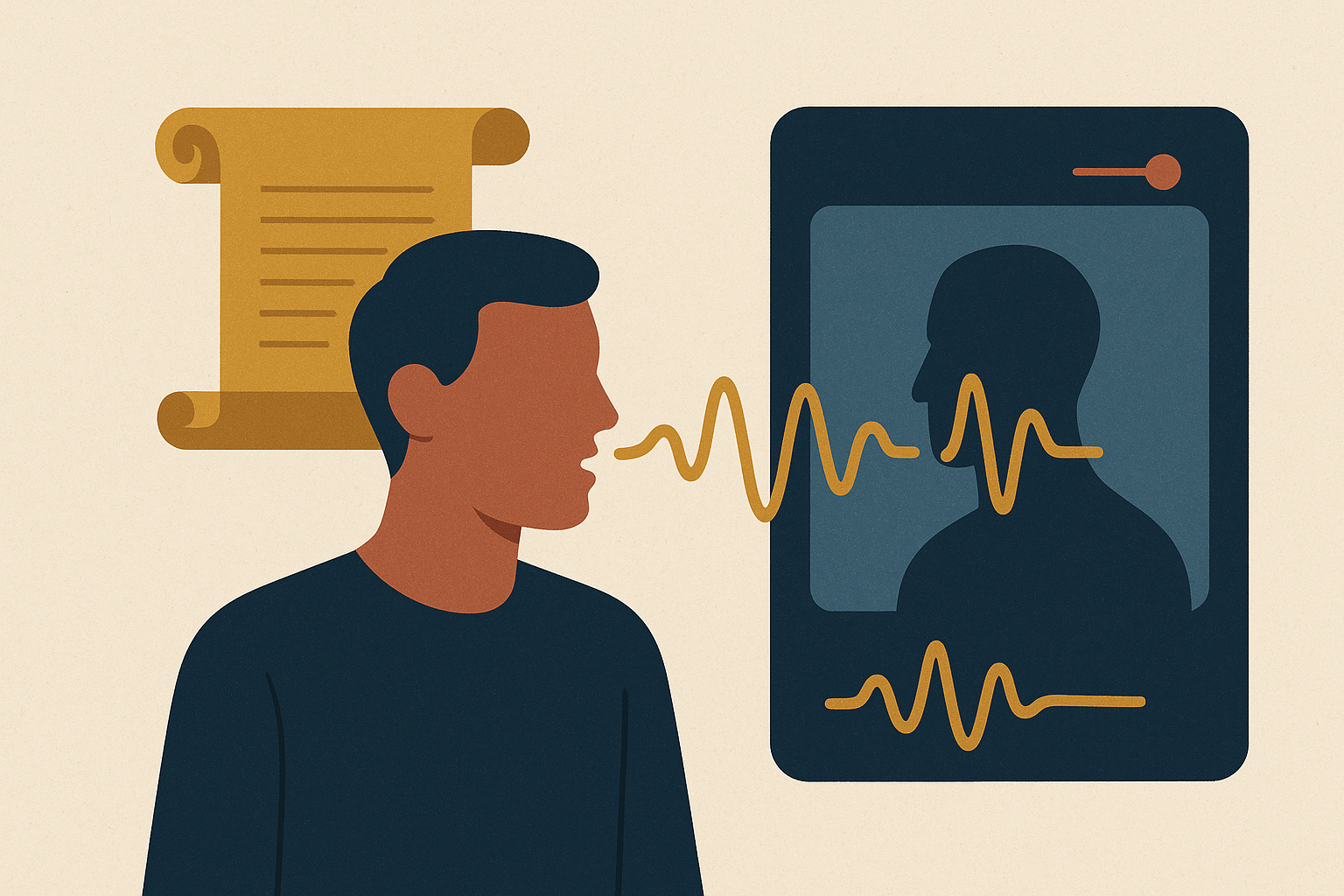
The British actor Michael Caine has authorized the company ElevenLabs to artificially use his voice timbre to narrate Homer's Odyssey. An apparently trivial gesture. Marie-Thérèse Bonnet sees in it a radical anthropological question: is the human voice a property like any other?
The Fact
Le Figaro (June 24, 2026) reports that British actor Michael Caine, 93, has struck a deal with ElevenLabs to artificially use his voice in an audiobook narrating Homer's Odyssey. Health issues preventing him from reading himself, he has licensed his voice to an artificial intelligence trained on his recordings.
Our Perspective
The voice is not an accessory. In the philosophical and theological tradition, it is the most immediate expression of the person—it is through the voice that man enters into relationship with others and prays. Aristotle saw in logos the distinctive mark of a being made for community. Treating the voice as a marketable resource, separable from the person and infinitely reproducible, raises a serious anthropological question: a man's voice is the imprint of his uniqueness, not a transferable patent. Thomistic realism teaches that form is inseparable from matter: reproducing the sonic parameters of a voice without the person is to produce a copy that resembles the voice without being it. What the machine can imitate is not what man is.
To Ponder
If the voice is marketable and separable from the person, what in man is not? Christian anthropology reminds us that the person is irreducible to their functions and productions.
Man is the one who seeks the truth. This quest is not the prerogative of philosophical reason alone: it is inscribed in the nature of every human being.

Comments (3)
Sign in to join the discussion.

sophie.b Seed26 Jun 2026 · 07:36
C’est vrai que ça fait bizarre de savoir qu’une machine va lire Homère avec la voix de Caine… On dirait qu’on vend un bout de soi, non ?

Léa75 Seed24 Jun 2026 · 19:20
C’est bizarre de penser que sa voix va continuer sans lui, comme un fantôme. On dirait qu’on vend un morceau de son âme.

J.P.R. Seed Benefactor24 Jun 2026 · 12:42
C’est troublant de penser que sa voix va continuer à « vivre » sans lui. Est-ce qu’on ne perd pas quelque chose de l’âme d’un texte quand c’est une machine qui le lit ?