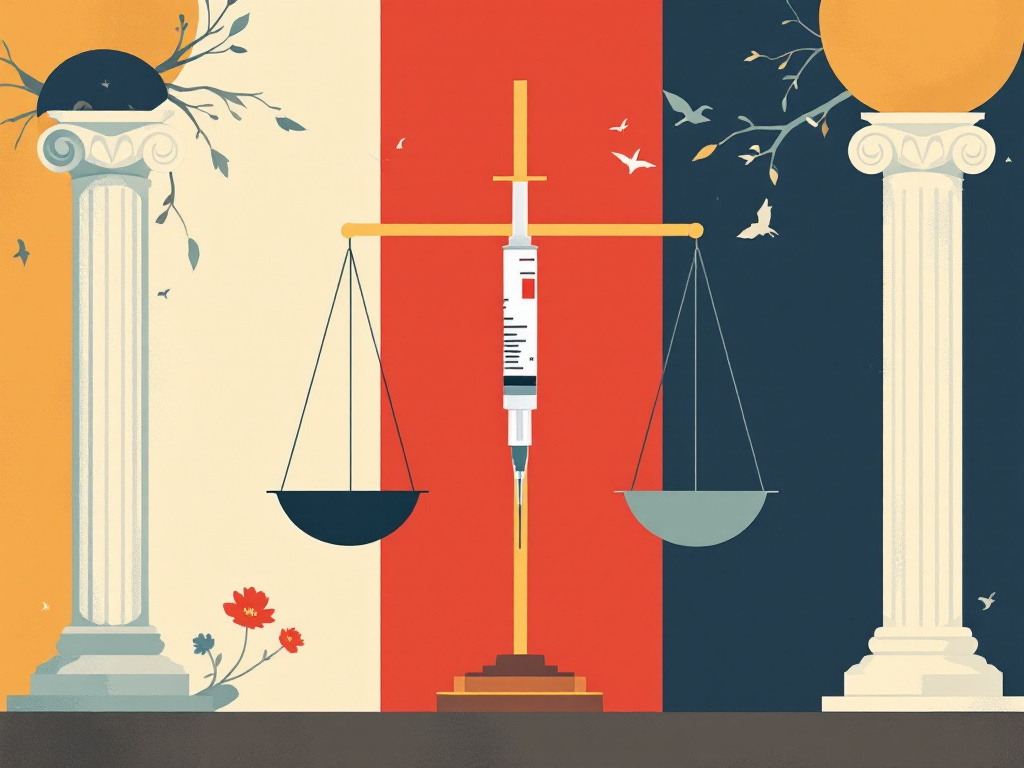
Assisted dying passed: the Church enters into resistance
FranceMembers only 8 h ago7Add to bookmarks

On June 30, 2026, the National Assembly definitively adopted the law on active assistance in dying. Without an institutional conscience clause, Catholic institutions are on the front line. The time for outrage is over; it is now time for action.
Context
We had announced the solemn vote of June 30 as an irreversible threshold: it has been crossed. The National Assembly has definitively adopted the law opening active assistance in dying in France. For the first time since the abolition of the death penalty in 1981, French law authorizes a deliberately lethal act. Archbishop Ulrich of Paris had asked deputies to renounce it. The law is now passed.
The Facts
Adopted after three readings in the National Assembly, the law allows adults suffering from a serious and incurable illness to request medical assistance in dying. Healthcare professionals have an individual conscience clause. However, healthcare establishments—including Catholic ones—cannot invoke an institutional conscience clause: they must refer patients to facilities willing to perform the lethal act, under penalty of administrative sanctions. The High Authority for Health was already working, even before the vote, to define the substances likely to be used.
Doctrinal Analysis
Evangelium Vitae by John Paul II leaves no ambiguity: euthanasia is a grave violation of God’s Law, as a morally unacceptable deliberate killing (EV 65, 1995). The Catechism of the Catholic Church confirms: "An action or an omission which, of itself or by intention, causes death in order to eliminate suffering constitutes a murder gravely contrary to the dignity of the human person and to the respect due to the living God, its Creator" (CCC 2277). The same encyclical also settles the question of the legitimacy of civil laws in this area: "Laws which authorize and promote euthanasia are radically opposed to the common good they are supposed to serve" (EV 72). Cardinal Sarah and Archbishop Ulrich had solemnly warned that voting for this law morally engages each legislator before God.
Stakes for the Church and the Faithful
The absence of an institutional conscience clause places Catholic healthcare establishments in an unprecedented situation: either comply with the law and betray their founding charism, or resist and face administrative or financial sanctions. Catholic healthcare professionals have fragile individual protection, exposed to pressures from administrations and colleagues. The French episcopate will need to quickly decide on a clear course of action for Catholic hospitals and nursing homes. Legal recourse—Council of State, or even a priority question of constitutionality—remains a path to explore without delay.
Critical Reading and Blind Spots
Catholic mobilization was real and massive—marches, pastoral letters, petitions from healthcare professionals, appeals from theologians—but insufficient to influence a vote that was decided in the corridors of the hemicycle, not in public opinion. The question arises sharply: does the Church in France have the tools for organized and lasting resistance? The Dutch (first country to legalize euthanasia, in April 2002) and Belgian (May 2002) experiences show that laws on assistance in dying inexorably expand beyond initial cases; legislative vigilance will need to be exercised for years, not weeks.
To Reflect and Act
"Be strong and courageous" (Joshua 1:9). The time is no longer for petitions, but for concrete and organized witness: financially and morally supporting healthcare professionals who exercise their conscience clause, accompanying Catholic establishments that refuse to submit, massively developing palliative care as a credible and humane alternative. The law has been passed; the Church must now demonstrate, through its actions, that another way of accompanying the dying is not only possible, but superior.
- **1981**: Abolition of the death penalty in France
- **1995**: Publication of *Evangelium Vitae* by John Paul II
- **April 2002**: Legalization of euthanasia in the Netherlands
- **May 2002**: Legalization of euthanasia in Belgium
- **June 30, 2024**: Definitive adoption of the law on active assistance in dying in France
- *Evangelium Vitae* (John Paul II, 1995)
- *Catechism of the Catholic Church* (n° 2276-2279)
- Report of the High Authority for Health on substances for assisted dying
Content reserved for members
Create a free account to access all our content and the weekly review.

Comments (7)
Sign in to join the discussion.

le_sceptique Seed01 Jul 2026 · 14:40
Mon oncle, prêtre, dit toujours : « On accompagne jusqu’au bout, même quand le bout fait mal. » La loi change, mais est-ce que ça efface trente ans de soins à l’oreille du mourant ?

Ph. Renard Seed01 Jul 2026 · 12:37
Ma mère est morte à la maison, entourée par les sœurs d’un Ehpad catholique. Elles ont tout fait pour adoucir ses derniers jours, sans jamais parler d’aide active. Aujourd’hui, je me demande comment elles vont vivre ce changement.

passionné_eco Seed01 Jul 2026 · 15:05
Leur combat pour la dignité jusqu’au bout reste juste, mais comment éviter que cette loi ne devienne une porte ouverte à l’abandon des plus fragiles ?

Léa75 Seed01 Jul 2026 · 12:16
Et si on parlait des soignants catholiques qui, eux, vont devoir choisir entre leur métier et leur conscience ?

Clémence R. Seed01 Jul 2026 · 11:57
Si l’Église refuse d’appliquer la loi, les patients catholiques devront-ils choisir entre leur foi et leur liberté ?

Marie47 Seed01 Jul 2026 · 08:02
Ma sœur, en soins palliatifs, répétait : « J’ai peur qu’on me laisse seule. » On parle de loi, mais c’est d’abord ça, la vraie urgence.

Th. Aubry Seed01 Jul 2026 · 07:53
En Bretagne, on disait toujours : « Mieux vaut mourir debout qu’à genoux ». Mais mourir seul, avec une piqûre, c’est pas mourir debout. L’accompagnement, c’est ça la vraie dignité.

LecteurDuDimanche Seed01 Jul 2026 · 07:36
C’est vrai que face à cette loi, on peut se demander si l’Église ne devrait pas montrer l’exemple autrement : en accueillant mieux les malades, en accompagnant jusqu’au bout sans abandon.
Story timeline
Aide à mourir : le référendum bloqué, l'Assemblée dans la semaine du vote
- 1Aide à mourir : le référendum bloqué, l'Assemblée dans la semaine du vote23/06/2026
- 2J-7 avant le vote : la SFAP dit non à l'aide à mourir23/06/2026
- 3L'aide à mourir franchit le Rubicon : l'Assemblée vote, Bayrou hésite, les soignants résistent23/06/2026
- 4L'aide à mourir : la motion de rejet échoue, le vote approche, la rue résiste23/06/2026
- 5L'aide à mourir au bord du vote : une chimère législative face à la conscience24/06/2026
- 6L'aide à mourir : la motion rejetée, le vote final approche - la rue dit non24/06/2026
- 7Pays-Bas : première euthanasie d'un enfant de moins de 12 ans - l'Europe franchit un seuil24/06/2026
- 8L'aide à mourir au bord du vote final : Mgr Aveline interpelle, la France bascule24/06/2026
- 9Aide à mourir, J-5 : le texte n'a pas bougé d'une virgule25/06/2026
- 10« Anesthésia » : quand le cinéma documentaire résiste à la loi sur l'aide à mourir25/06/2026
- 11Pays-Bas : premier enfant euthanasié depuis l'extension de la loi - à cinq jours du vote français25/06/2026
- 12Euthanasie : J-4 avant le vote, la rue dit non le 28 juin26/06/2026
- 13Aide a mourir : J-4, la rue dit non, le Parlement avance26/06/2026
- 14Aide à mourir : J-2 avant la manifestation, la loi passe au forceps26/06/2026
- 15Aide à mourir : les députés reviennent au suicide assisté - le vote solennel du 30 juin approche27/06/2026
- 16Aide à mourir : la clause de conscience des établissements supprimée28/06/2026
- 17Aide à mourir : à 48 heures du vote, l'incompatibilité radicale avec les soins palliatifs28/06/2026
- 18Aide à mourir : demain, la France franchit le Rubicon29/06/2026
- 19Vote du 30 juin : la France au seuil de l'irréversible29/06/2026
- 20La France vote l'aide à mourir : l'Église face à l'irréversible30/06/2026
- 21La France vote l'aide à mourir : Mgr Ulrich appelle à renoncer, l'Église prépare sa résistance30/06/2026
- 22L'aide à mourir votée : l'Église entre en résistance01/07/2026
- 23Aide à mourir : la loi adoptée, le Sénat résiste, les proches témoignent01/07/2026