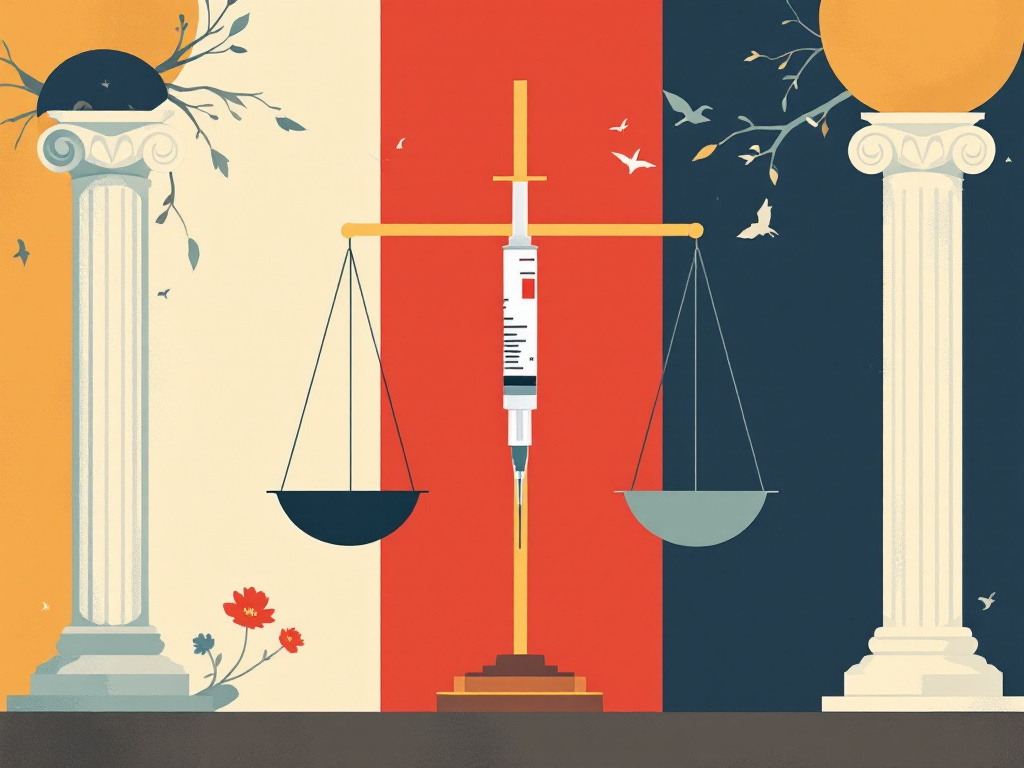
Assisted dying: the conscience clause for institutions removed
FranceMembers only Jun 28, 20264Add to bookmarks

With forty-eight hours to go before the solemn vote, the so-called end-of-life assistance law crosses an unprecedented threshold: healthcare establishments—including Catholic ones—will no longer be able to collectively refuse to perform the lethal act on their patients. Institutional freedom of conscience is abolished.
Context
Week after week, we followed the progress of this text, described by its proponents as a "triumph of freedom." On June 27, MPs completed the new reading. The solemn vote is scheduled for June 30, 2026. However, one provision, less publicized than the debate on assisted suicide or lethal injection, risks producing lasting and profound effects on the entire French healthcare system: the removal of the institutional conscience clause.
Facts
As the adopted text currently stands, healthcare establishments—clinics, hospitals, retirement homes, EHPADs—will not have the right to declare themselves structurally opposed to the practice of assisted dying. Only individual healthcare professionals retain a personal conscience clause. But the establishment itself, as a legal entity, cannot object.
In practice: a Catholic clinic or a palliative care home run by a religious congregation will not be able to include the exclusion of lethal acts in its internal regulations or statutes. If an eligible patient requests it, the establishment will have to either perform the act or "redirect" the patient—that is, organize their transfer to an accepting facility.
Gènéthique reports the wording of the joint committee: the establishment must "guarantee continuity of care." In reality, this means participating in the organizational chain of induced death.
Doctrinal Analysis
The Gospel of Life is unambiguous: "formal cooperation in an intrinsically evil action can never be justified" (Evangelium Vitae, n. 74). Immediate material cooperation—organizing the transfer of a patient to receive a lethal act—is proximate cooperation that engages the moral responsibility of the institution.
The Catechism of the Catholic Church teaches in n. 2277 that "any act that directly causes the death of disabled, sick, or dying human beings is morally unacceptable murder." Forcing a Catholic institution to be part of the organizational chain of this act is to strip it of its ability to be what it is: a place where care is provided without killing.
Institutional religious freedom, guaranteed by Article 9 of the European Convention on Human Rights, protects not only individual believers but also institutions that act according to their religious convictions. The jurisprudence of the European Court of Human Rights (ruling Obst v. Germany, 2010; ruling Siebenhaar v. Germany, 2011) recognizes the right to institutional autonomy for denominational institutions. The removal of the institutional conscience clause opens a path for litigation before the ECHR that Catholic institutions would be wrong to overlook.
Stakes for the Church and the Faithful
Catholic-inspired healthcare establishments represent a significant portion of France's hospital capacity, particularly in geriatrics and palliative care. Forcing these establishments to "redirect" their patients toward death is a direct attack on their mission. Archbishop Aveline had stated clearly: "One cannot disguise the act of causing death as a gesture of care."
The Church in France now faces an institutional choice: either submit to the law and become complicit in the lethal chain, or resist and expose itself to sanctions. From the moment the law is promulgated, leaders of Catholic establishments will need to examine the exact scope of the text with their legal advisors and their referring bishops.
Critical Reading and Blind Spots
The law carefully distinguishes between individual conscience (protected) and institutional conscience (abolished). This distinction is not neutral: it specifically aims to bypass denominational institutions. It is worth noting that three left-wing MPs—Belluco, Potier, and Peu—voted against, and Prime Minister Bayrou publicly expressed reservations. These cracks do not change the outcome, but they signal that moral consensus, even on the left, is not assured.
The citizen movement "Nos mourants ne sont pas des encombrants" ("Our dying are not burdens") continues to bring together caregivers and families. After the vote, it will embody civil resistance to a law whose concrete effects will need to be evaluated over time.
To Reflect and Act Upon
"Woe to those who call evil good, and good evil" (Is 5:20). Conscience is not an individual luxury: it is the foundation of any institution that claims to heal in the name of a vision of humanity. May the faithful support their Catholic healthcare establishments through their presence, their prayers, and, if necessary, organized legal resistance.
Content reserved for members
Create a free account to access all our content and the weekly review.

Comments (4)
Sign in to join the discussion.

C. Moreau Seed28 Jun 2026 · 07:41
C’est bien beau de parler de liberté, mais on force les hôpitaux catholiques à faire ce qu’ils refusent depuis toujours. Où est la logique ?

unLecteur33 Seed28 Jun 2026 · 07:40
C’est bien ça le problème : si l’hôpital doit le faire, comment être sûr que le patient ne se sentira pas poussé à demander ça pour « libérer un lit » ou ne pas déranger ?

Marie47 Seed28 Jun 2026 · 07:16
C’est dur à avaler : on va obliger nos hôpitaux catholiques à faire ce qu’ils refusent depuis toujours. Où est le respect pour ceux qui soignent autrement ?

Clémence R. Seed28 Jun 2026 · 07:06
Supprimer cette clause, c'est forcer les hôpitaux catholiques à faire ce qu'ils refusent depuis toujours. On nous dit que c'est pour la liberté, mais où est la nôtre ?
Story timeline
Aide à mourir : le référendum bloqué, l'Assemblée dans la semaine du vote
- 1Aide à mourir : le référendum bloqué, l'Assemblée dans la semaine du vote23/06/2026
- 2J-7 avant le vote : la SFAP dit non à l'aide à mourir23/06/2026
- 3L'aide à mourir franchit le Rubicon : l'Assemblée vote, Bayrou hésite, les soignants résistent23/06/2026
- 4L'aide à mourir : la motion de rejet échoue, le vote approche, la rue résiste23/06/2026
- 5L'aide à mourir au bord du vote : une chimère législative face à la conscience24/06/2026
- 6L'aide à mourir : la motion rejetée, le vote final approche - la rue dit non24/06/2026
- 7Pays-Bas : première euthanasie d'un enfant de moins de 12 ans - l'Europe franchit un seuil24/06/2026
- 8L'aide à mourir au bord du vote final : Mgr Aveline interpelle, la France bascule24/06/2026
- 9Aide à mourir, J-5 : le texte n'a pas bougé d'une virgule25/06/2026
- 10« Anesthésia » : quand le cinéma documentaire résiste à la loi sur l'aide à mourir25/06/2026
- 11Pays-Bas : premier enfant euthanasié depuis l'extension de la loi - à cinq jours du vote français25/06/2026
- 12Euthanasie : J-4 avant le vote, la rue dit non le 28 juin26/06/2026
- 13Aide a mourir : J-4, la rue dit non, le Parlement avance26/06/2026
- 14Aide à mourir : J-2 avant la manifestation, la loi passe au forceps26/06/2026
- 15Aide à mourir : les députés reviennent au suicide assisté - le vote solennel du 30 juin approche27/06/2026
- 16Aide à mourir : la clause de conscience des établissements supprimée28/06/2026
- 17Aide à mourir : à 48 heures du vote, l'incompatibilité radicale avec les soins palliatifs28/06/2026
- 18Aide à mourir : demain, la France franchit le Rubicon29/06/2026
- 19Vote du 30 juin : la France au seuil de l'irréversible29/06/2026
- 20La France vote l'aide à mourir : l'Église face à l'irréversible30/06/2026
- 21La France vote l'aide à mourir : Mgr Ulrich appelle à renoncer, l'Église prépare sa résistance30/06/2026
- 22L'aide à mourir votée : l'Église entre en résistance01/07/2026
- 23Aide à mourir : la loi adoptée, le Sénat résiste, les proches témoignent01/07/2026