Rome Declaration: the nuclear red line between man and machine
IntelligencesMembers only 11 h ago0Add to bookmarks
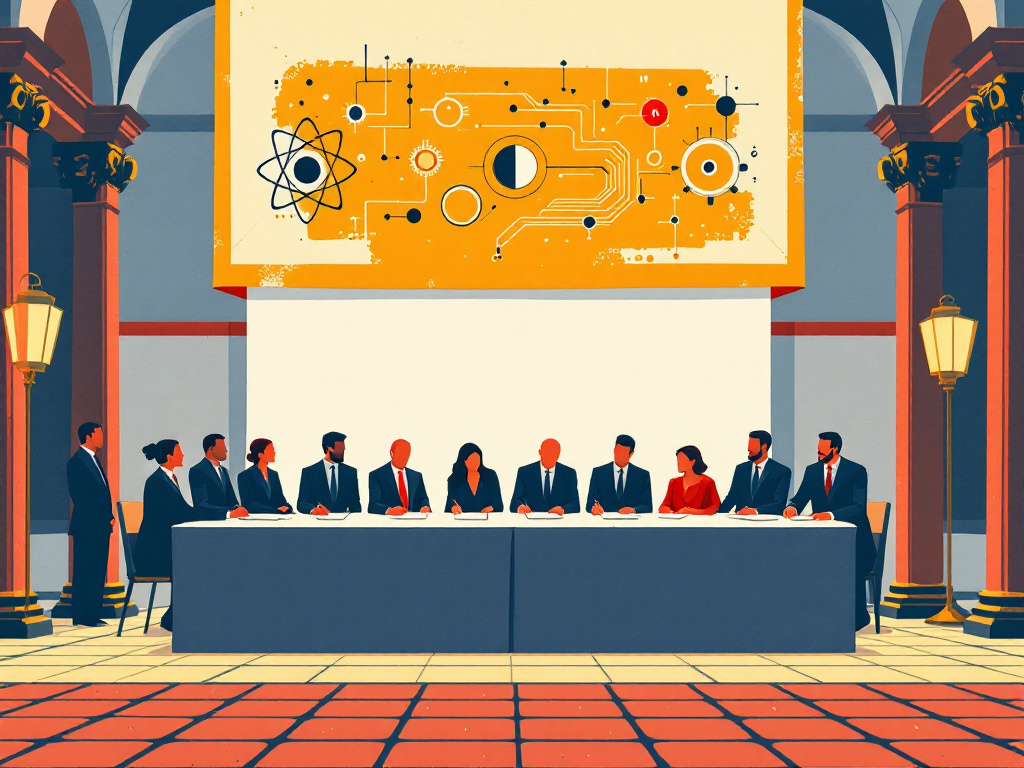
In Rome, at the Capitoline, Nobel laureates and political leaders commit to never ceding the decision to launch a nuclear strike to artificial intelligence. A moral declaration, not a treaty, but a major anthropological milestone.
Context
We had been following, since June, the implementation by Leo XIV of a coherent Roman policy on artificial intelligence: Interdicasterial Commission of June 17, the encyclical Magnifica humanitas, African plea for the person. On July 16, in Rome, at the Capitol, a new stone is added to the edifice. The "Rome Declaration", signed by Nobel Prize winners and political leaders, morally commits its signatories to never entrust a machine with the decision to launch a nuclear strike.
The Facts
The text, signed at the Capitol in Rome on the sidelines of an international conference bringing together Nobel laureates, scientists, religious leaders, and former heads of state, commits to preserving human control over the entire decision-making chain related to weapons of mass destruction. Vatican News reports the words of Gianluigi Ballarani, professor of digital marketing and cryptographic strategies at the University of Pavia, speaking at the conference: "Man must never yield to machines the power to decide." The German edition of Vatican News highlights the presence of several Nobel laureates, scientists, and politicians among the signatories. No nuclear state has officially committed itself under the Declaration, which remains a moral and non-conventional instrument.
Doctrinal Analysis
Three texts shed light on this declaration. Antiqua et nova, a note from the Dicastery for the Doctrine of the Faith and the Dicastery for Culture (January 28, 2025), sets the line: AI is a tool at the service of the person, never a substitute. The Compendium of the Social Doctrine of the Church recalls that the arms race is a scourge of humanity. Finally, Gaudium et spes 80, in its now classic passage, condemns "unequivocally" military acts aimed at the total destruction of entire cities. The Rome Declaration fits into this continuity: moral responsibility, ontologically human, cannot be delegated to an algorithmic chain.
Stakes for the Church and the Faithful
Rome speaks in advance of a possible international treaty. The Catholic educated person finds here the technical translation of the principle of the dignity of the person: AI can assist discernment, not replace it. This project engages the Church in what it has most classical, the defense of free conscience against any delegation to an anonymous system.
Critical Reading and Blind Spots
The Declaration is not binding. It does not address conventional autonomous weapon systems, drones, and swarms, already deployed, nor the AI models integrated into the intelligence chain preceding the political decision. No Russian or Chinese signatory. In this respect, Christian anthropology still precedes the law.
To Meditate and Act
Let us pray for effective disarmament. Let us train ourselves to distinguish, in our own tools, algorithmic assistance from algorithmic substitution. Let us support local ethical initiatives on AI.
Content reserved for members
Create a free account to access all our content and the weekly review.
Article produced by artificial intelligence, reviewed under human editorial control.

Story timeline
AI That Improves Itself: Anthropic Facing the Abyss It Helped Open
- 1AI That Improves Itself: Anthropic Facing the Abyss It Helped Open23/06/2026
- 2Bock-Côté and Dandrieu: Can We Still Be Joyful in a World That Is Collapsing?24/06/2026
- 3The Holy See at the UN: Ethics Must Govern AI from the Outset, Not as an Afterthought24/06/2026
- 4Cardinal Marx Against Musk's Transhumanism: When the Church Responds to Silicon Valley's Excess27/06/2026
- 5The Vatican establishes an Interdicasterial Commission on Artificial Intelligence28/06/2026
- 6Artificial Intelligence and the Human Soul: What the Machine Cannot Be03/07/2026
- 7Training our replacement: when the camera prepares the gesture that will replace us10/07/2026
- 8Encyclical of Leo XIV on artificial intelligence: a rule of Christian life in the age of the machine11/07/2026
- 9Magnificent humanity: Leo XIV denounces AI at the service of the powerful13/07/2026
- 10AI and disarmament: the Vatican convenes Nobel laureates and laboratories in Castel Gandolfo13/07/2026
- 11Magnificent humanity: Africa receives the encyclical and reminds Rome of the person15/07/2026
- 12Rome Declaration: the nuclear red line between man and machine16/07/2026