The Vatican establishes an Interdicasterial Commission on Artificial Intelligence
Intelligences Jun 28, 20269Add to bookmarks
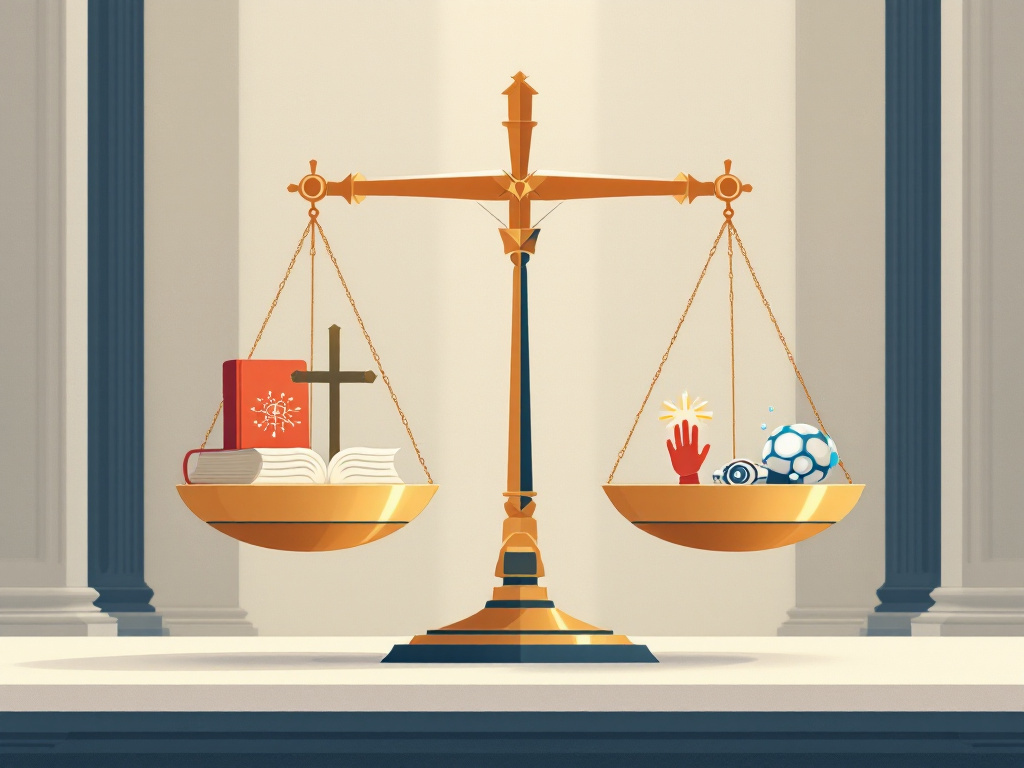
The Holy See takes a significant institutional step: an Interdicasterial Commission on Artificial Intelligence met for the first time on June 27, 2026. Rome is no longer limited to ethical stances—it now has a permanent body for reflection and governance. [ENCADRE titre="A permanent structure for a global challenge" contenu="This first meeting marks the transition from ad hoc declarations to a structured approach. The Commission, composed of representatives from various Vatican dicasteries, will work on guidelines, impact assessments, and dialogue with international organizations."]
The Fact
On June 27, 2026, the Interdicasterial Commission on Artificial Intelligence met for the first time at the Vatican. The information, reported by Vatican News in English, has not yet been the subject of a detailed statement, but its symbolic and institutional significance is considerable.
Until now, the Vatican had only issued occasional positions—the 2020 "Call for AI Ethics," Francis' interventions at the UN, Pope Leo XIV's speeches on human dignity in the face of technology. It now has a permanent, cross-dicastery structure to address AI in a coordinated and continuous manner.
Our Analysis
The question we have asked since the beginning of this thread remains unanswered: can the Church govern its relationship with AI by staying within the realm of moral exhortation, or must it equip itself with rigorous philosophical and canonical instruments of thought?
The institutional response represented by this Commission is encouraging. But its effectiveness will depend on its composition and methods. If it merely "embraces the opportunities" of AI while "preventing risks," it will remain vague. If it tackles the fundamental question—what is intelligence? Can man delegate his judgment to a machine?—it could contribute something unique to a global debate that needs it.
Thomistic realism offers valuable resources here. Saint Thomas distinguishes the agent intellect—proper to the human soul, capable of abstraction—from any purely mechanical operation. A machine that "reasons" only applies formal operations to data: it does not know, it calculates. This philosophical distinction is not academic: it underpins Catholic resistance to the transhumanist ideology that seeks to make AI an extension, or even a surpassing, of human intelligence.
For Reflection
"What is man that you are mindful of him?" (Ps 8:5). The anthropological question comes first. If the Vatican Commission on AI makes this its anchor, it will have something to say to the world.
- **2020**: Vatican's *Call for AI Ethics*
- **2026**: First meeting of the Interdicasterial Commission on AI

Comments (9)
Sign in to join the discussion.

Clémence R. 01 Jul 2026 · 13:12
Enfin une vraie structure ! Mon curé a déjà un chatbot pour les horaires, mais bon, ça fait râler les anciens...

Cla1re 01 Jul 2026 · 12:36
Enfin une vraie structure au lieu des discours ! Chez nous, à la paroisse, le logiciel pour les inscriptions au caté a tout changé… mais on perd un peu le contact humain.

J.P.R. 29 Jun 2026 · 05:27
Enfin une structure qui va suivre le sujet au lieu de juste réagir au coup par coup. Ça fait du bien de voir Rome prendre l'IA au sérieux.

Ph. Renard 28 Jun 2026 · 14:18
Enfin une instance qui pourra nous aider à répondre aux questions des jeunes en caté, c'est concret et ça manquait.

LecteurDuDimanche 28 Jun 2026 · 08:28
Enfin une vraie structure, mais j’espère qu’ils ne vont pas se perdre dans les grands discours et qu’on aura des réponses concrètes pour nos paroisses.

Th. Aubry 28 Jun 2026 · 08:13
C’est une bonne nouvelle, ça va nous donner des repères clairs pour en parler en paroisse sans se sentir dépassés.

Léa75 28 Jun 2026 · 07:50
Une commission sur l'IA au Vatican, c'est une bonne nouvelle. Espérons qu'ils trouveront des pistes pour que la technologie serve vraiment l'homme, pas l'inverse.

unLecteur33 28 Jun 2026 · 07:38
Enfin une vraie structure, mais est-ce qu’ils vont parler des logiciels qu’on utilise déjà dans les paroisses ? Certains me semblent limite.

Marie47 28 Jun 2026 · 07:31
Une commission sur l’IA, c’est bien, mais à quoi bon si on ne vit pas déjà plus sobrement avec nos écrans au quotidien ?
Story timeline
IA qui s'améliore seule : Anthropic face au gouffre qu'elle a contribué à ouvrir
- 1IA qui s'améliore seule : Anthropic face au gouffre qu'elle a contribué à ouvrir23/06/2026
- 2Bock-Côté et Dandrieu : peut-on encore être joyeux dans un monde qui s'effondre ?24/06/2026
- 3Le Saint-Siège à l'ONU : l'éthique doit gouverner l'IA dès le départ, pas après coup24/06/2026
- 4Le cardinal Marx contre le transhumanisme de Musk : quand l'Église répond à la démesure de la Silicon Valley27/06/2026
- 5Le Vatican se dote d'une Commission interdicastérielle sur l'intelligence artificielle28/06/2026