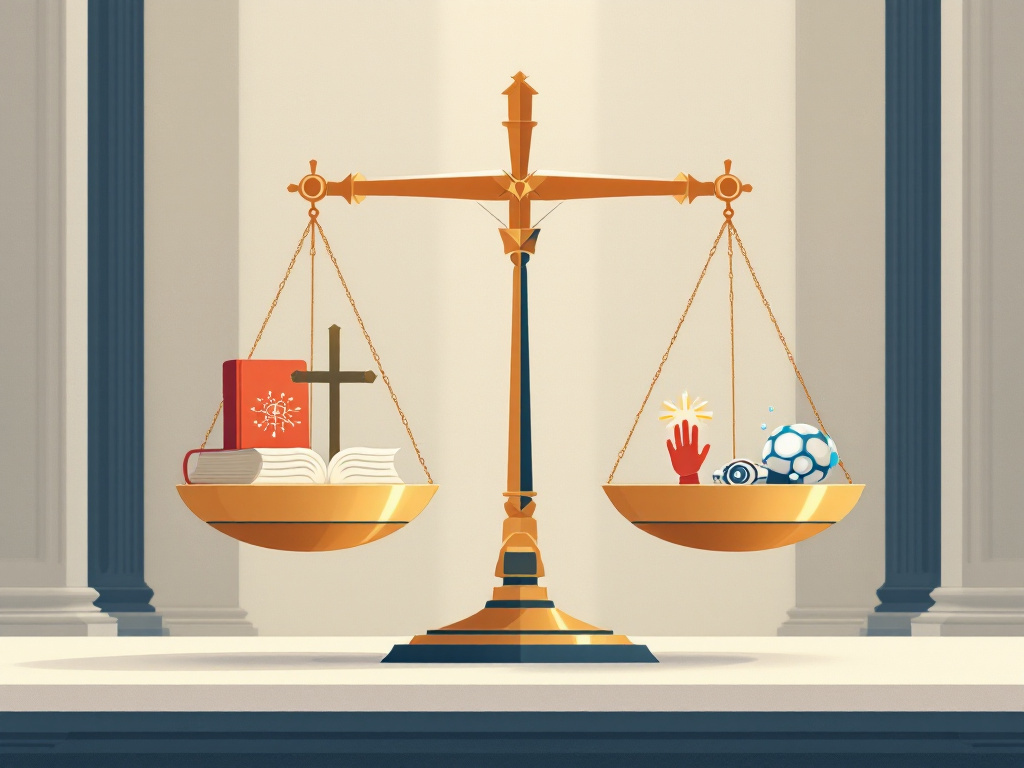
The Holy See at the UN: Ethics Must Govern AI from the Outset, Not as an Afterthought
IntelligencesMembers only Jun 24, 20263Add to bookmarks

The Vatican delegation to the United Nations stated unequivocally: assessing the risks of AI is an act of responsibility. And ethical discernment must precede technical choices, not accompany them after the fact.
Context
We had been following the issues of digital sovereignty and the Church's positions on the development of artificial intelligence. On June 23, 2026, the Permanent Observer Mission of the Holy See to the United Nations in New York spoke during the work of the scientific group tasked with developing recommendations on the impact of AI. The Roman position is unambiguous: ethical discernment must precede and guide technical choices, not accompany them after the fact.
The Facts
The Vatican delegation welcomed the mandate given to the UN's scientific group and stated: "The assessment of AI risks is an act of responsibility." Rome supports the creation of a global AI governance framework that integrates fundamental ethical criteria from the design phase, foremost among which is the protection of human dignity.
This intervention follows the continuity of "Magnifica humanitas" by Leo XIV (May 25, 2026), the first papal encyclical to address AI as a central anthropological issue. It also extends the "Rome Call for AI Ethics," signed in 2020 by the Holy See with Microsoft and IBM.
Doctrinal Analysis
The question is not technical: it is anthropological. "What is man that you are mindful of him?" (Ps 8:5). Faced with a technology that simulates thought, imitates voice, and generates images of real people, the question of what is uniquely human becomes urgent again.
Thomas Aquinas teaches that reason is the specific principle of human activity (Summa Theologica I-II, q. 18, a. 5): it is intentional, oriented toward the good. An AI, no matter how advanced, operates according to statistical probabilities, not moral intentionality. Confusing the two is to succumb to what "Magnifica humanitas" calls "the Promethean illusion"—believing that technology can equal or replace the human person created in the image of God (Gen 1:27).
The Church's Social Doctrine recalls the precautionary principle: every technology must be evaluated in light of the common good and the integral dignity of the human person (Caritas in Veritate, Benedict XVI, 2009, n. 70).
Challenges for the Church and the Faithful
The Vatican's intervention at the UN is not symbolic. The Holy See is a permanent observer at the United Nations and participates in negotiations on digital treaties currently underway. Its voice can influence AI governance standards if it is carried out with consistency and competence.
For the faithful: every use of AI is an ethical decision. Delegating judgments about people—hiring, credit, childcare, judicial sentences—to algorithms means entrusting to a machine what belongs to moral conscience.
Critical Perspective and Blind Spots
The risk of the Vatican's position is that it remains declarative. "Ethics must precede technology" is a true proposition, but without precise institutional proposals, it remains ineffective against the economic interests of large tech companies that fund the UN's expert groups.
The blind spot is internal: the Church itself uses AI to manage pastoral data, seminary selection processes, and institutional communications. What ethical governance has it established for itself?
To Reflect and Act Upon
"The truth will set you free" (Jn 8:32). Faced with tools that can manipulate reality, discernment is a spiritual virtue before being a technical skill. Training young Catholics in digital discernment—distinguishing information from simulation, the person from the avatar—is an evangelizing mission for our time.
- **2020**: Signing of the *Rome Call for AI Ethics* by the Holy See, Microsoft, and IBM.
- **May 25, 2026**: Publication of the encyclical *Magnifica humanitas* by Leo XIV.
- **June 23, 2026**: Vatican intervention at the UN on AI governance.
- *Caritas in Veritate* (Benedict XVI, 2009)
- *Summa Theologica* (Thomas Aquinas, I-II, q. 18, a. 5)
- *Rome Call for AI Ethics* (2020)
Content reserved for members
Create a free account to access all our content and the weekly review.

Comments (3)
Sign in to join the discussion.

passionné_eco 25 Jun 2026 · 17:22
Enfin une voix qui dit clairement que l'éthique ne doit pas être un simple correctif après coup. Les géants du numérique n'ont pas à décider seuls de notre avenir.

le_sceptique 25 Jun 2026 · 14:17
L’Église a raison sur le principe, mais on se demande parfois si elle ne devrait pas balayer devant sa porte avant de donner des leçons sur l’éthique.

J.P.R. 25 Jun 2026 · 07:09
Enfin une prise de position qui remet les choses à l'endroit : l'éthique d'abord, la technique après. Ça fait du bien de l'entendre à l'ONU.
Story timeline
IA qui s'améliore seule : Anthropic face au gouffre qu'elle a contribué à ouvrir
- 1IA qui s'améliore seule : Anthropic face au gouffre qu'elle a contribué à ouvrir23/06/2026
- 2Bock-Côté et Dandrieu : peut-on encore être joyeux dans un monde qui s'effondre ?24/06/2026
- 3Le Saint-Siège à l'ONU : l'éthique doit gouverner l'IA dès le départ, pas après coup24/06/2026
- 4Le cardinal Marx contre le transhumanisme de Musk : quand l'Église répond à la démesure de la Silicon Valley27/06/2026
- 5Le Vatican se dote d'une Commission interdicastérielle sur l'intelligence artificielle28/06/2026