Taliban in Brussels: The EU Persists in Negotiations Without an Ethical Compass
EuropeMembers only Jun 24, 20263Add to bookmarks
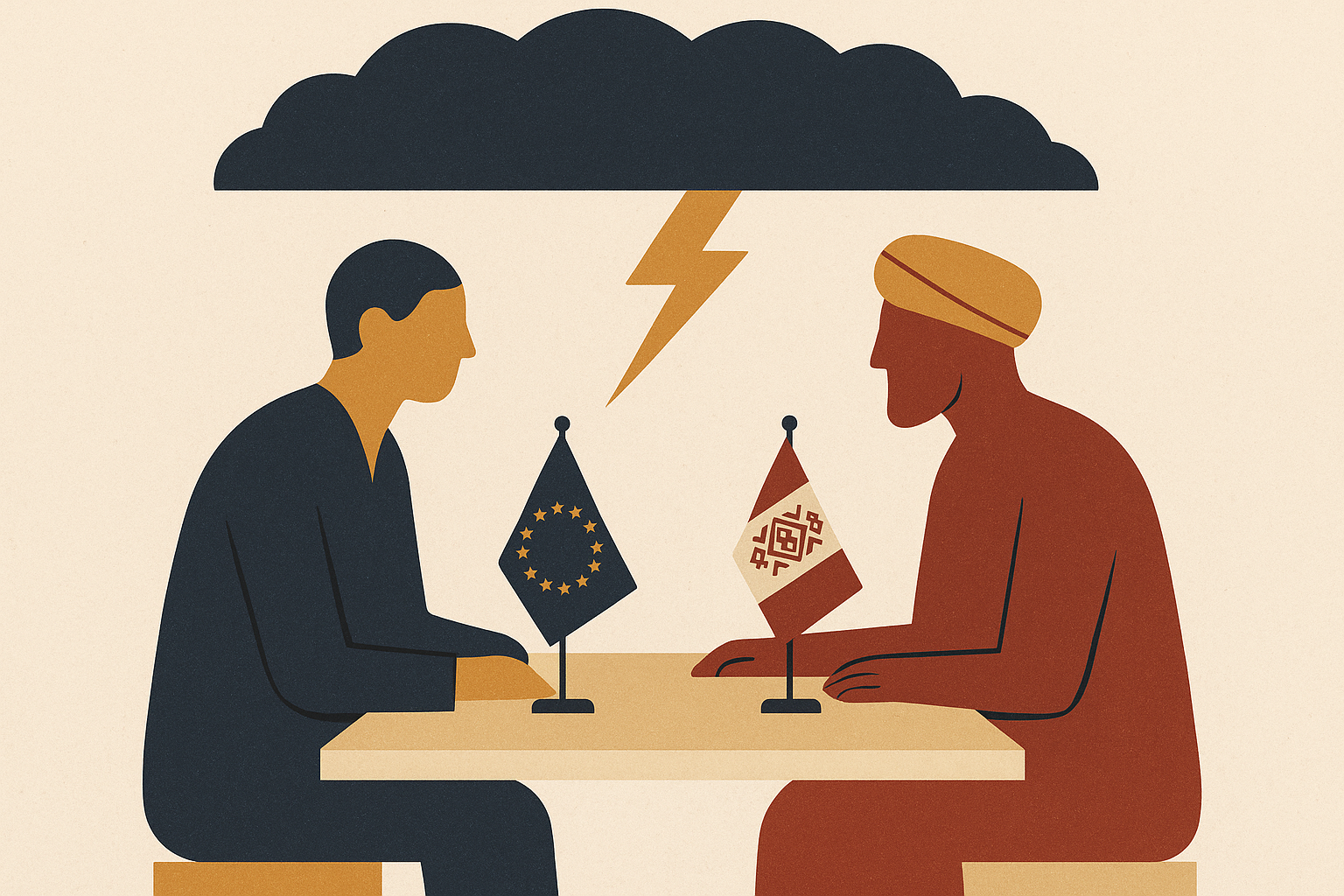
The Taliban delegation came to Brussels to negotiate the return of Afghan exiles. The same day in Rabat, Cardinal Parolin reminded that fraternity cannot be reduced to a utilitarian vision. Two languages that are completely opposed. François-Xavier Lemoyne deciphers the European paradox.
Context
In our previous editions, we followed the official invitation extended by the European Commission to a Taliban delegation to discuss the repatriation of Afghan exiles to their country. The week of June 23, 2026, provides further insight: Le Figaro publishes a detailed analysis of the mechanisms behind this visit, while the Secretary of State of the Holy See, Cardinal Parolin, spoke in Rabat with a message that serves as a counterpoint.
Facts
The European Commission invited an official delegation from the Islamist government of Kabul to consider the repatriation of Afghan exiles to their country, at the request of around twenty member states (Le Figaro, June 23, 2026). The Taliban have governed Afghanistan since August 2021. Under their regime, women are excluded from public spaces, secondary education, and universities. Religious minorities—including the very small Afghan Christian community, estimated at a few thousand people, most of whom are converts from Islam—live in absolute clandestinity. Conversion from Islam is punishable by death.
On the same June 23, 2026, Cardinal Pietro Parolin, Secretary of State of the Holy See, spoke in Rabat as a new honorary member of the Academy of the Kingdom of Morocco. He urged not to view fraternity with a "purely utilitarian vision," calling for a shift from mere "tolerance" to a genuine welcome of the other. Vatican News (June 23, 2026) reported his words.
Doctrinal Analysis
The Church's social doctrine is clear on the right to asylum. The Catechism teaches that "the more prosperous nations are obliged, to the extent they are able, to welcome the foreigner in search of the security and the means of livelihood which he cannot find in his country of origin" (CCC, no. 2241). But the same text adds: "Political authorities may subordinate the exercise of the right to immigrate to various juridical conditions." The issue is therefore not binary: neither unconditional welcome nor blind rejection satisfies the doctrine.
What is problematic in the EU-Taliban negotiations is something else: it is the act of legitimizing a regime that persecutes its own people by offering it international recognition. Sending Afghans back to a government that oppresses women, executes apostates, and bans all forms of non-Islamic worship exposes vulnerable individuals to documented danger.
Stakes for the Church and the Faithful
European Catholics—and particularly French Catholics—are directly challenged. Many of these Afghan exiles that the EU plans to repatriate fled precisely because of their faith or their ties to Western forces. Among them are converts to Christianity. Sending them back means exposing them to certain death.
By speaking of non-utilitarian fraternity in Rabat, Cardinal Parolin implicitly criticized what the EU is doing: treating Afghan migrants as a political adjustment variable rather than as human beings endowed with irreducible dignity.
Critical Perspective and Blind Spots
The main blind spot in the European debate on Afghan repatriations is the issue of converts. No official mechanism specifically protects Afghan converts to Christianity in the event of repatriation. Their situation is legally and practically different from that of other migrants, yet it is never mentioned in the Commission's official documents.
The Taliban's visit to Brussels also carries a dangerous symbolic dimension: it normalizes a regime that the EU has officially condemned multiple times for violating fundamental rights. Consistency between principled declarations and diplomatic actions is a credibility requirement that the EU cannot ignore indefinitely.
To Reflect and Act Upon
The fraternity Cardinal Parolin speaks of is not a sentimental option. It is an anthropological demand rooted in the common dignity of the human being, created in the image of God (Genesis 1:27). The Afghans the EU wishes to repatriate are men and women made in that image. Their fate concerns us.
The Afghan Christian community is estimated at a few thousand people, mostly converts from Islam. Under the Taliban regime, conversion is punishable by death. They live in absolute clandestinity, without any official place of worship. Source: Open Doors, World Watch List 2025.
Content reserved for members
Create a free account to access all our content and the weekly review.

Comments (3)
Sign in to join the discussion.

C.M. 26 Jun 2026 · 07:51
C’est à se demander s’ils ont encore une once de bon sens à Bruxelles. Comment on peut négocier avec des gens qui écrasent les femmes et les minorités ?

passionné_eco 25 Jun 2026 · 17:44
L’Europe se dit chrétienne, mais serrer la main à des gens qui lapident les femmes et pendent les homosexuels, c’est se moquer de nous.

Léa75 24 Jun 2026 · 15:47
Discuter avec les talibans alors qu’ils empêchent les filles d’étudier, c’est comme tendre la main en oubliant ce qu’on est.
Story timeline
Talibans à Bruxelles : l'UE négocie le retour des migrants afghans avec le régime islamiste
- 1Les talibans à Bruxelles : quand l'UE négocie l'expulsion des exilés avec un régime islamiste persécuteur23/06/2026
- 2Talibans à Bruxelles : l'UE persiste dans une négociation sans boussole éthique24/06/2026