The Taliban in Brussels: When the EU Negotiates the Expulsion of Exiles with an Islamist Persecuting Regime
EuropeMembers only Jun 23, 20262Add to bookmarks
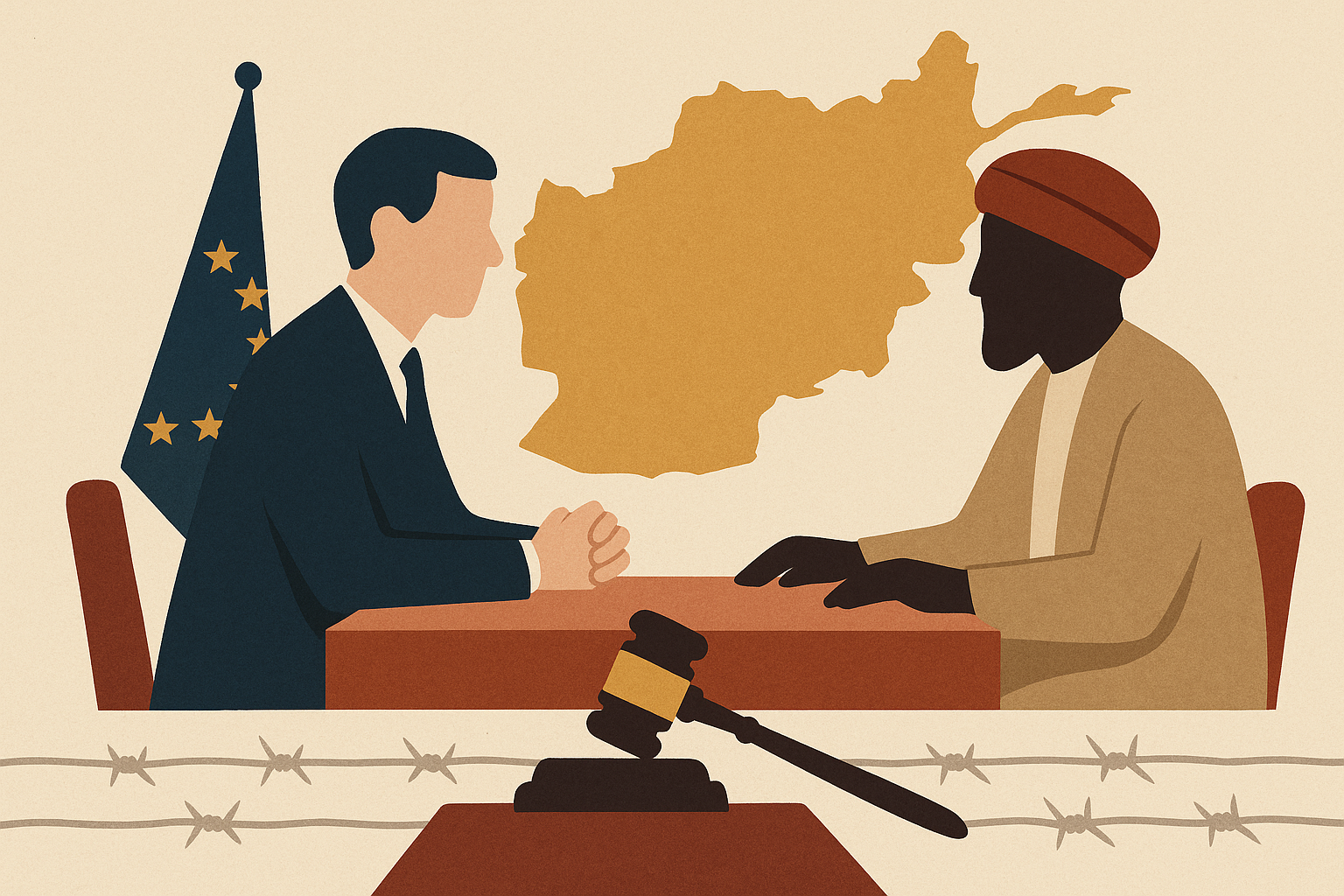
The European Commission received an official delegation from the Taliban government in Kabul to discuss the repatriation of Afghan migrants. A move that implicitly legitimizes a regime under which Afghan Christians directly suffer persecution.
Context
We had warned about the tensions between European migration policy and the defense of the rights of the most vulnerable, in the COMECE report on the European return regulation. The official visit of a Taliban delegation to Brussels, revealed by Le Figaro on June 23, 2026, marks another step in an ethically problematic direction.
The Facts
According to Le Figaro (June 23, 2026), the European Commission invited a delegation from the Islamist government of Kabul to consider the return of Afghan nationals to their country, at the request of around twenty Member States. This official visit falls within the framework of the European return regulation that COMECE had criticized. It implicitly legitimizes a regime that has abolished women's rights, persecuted religious minorities—including Christians—and imposed a rigorous interpretation of Sharia incompatible with any guarantee of individual protection.
Doctrinal Analysis
The Church's social doctrine is clear on two conflicting points: the right of states to control their immigration (Compendium of the Social Doctrine of the Church, no. 298) and the absolute duty not to return a person to a country where they risk persecution (the principle of non-refoulement, which the Church has supported since the Instruction Exsul Familia, Pius XII, 1952, up to the recent Magisterium of Francis). These two rights can only be balanced by ensuring that every return is voluntary, safe, and dignified.
However, under the Taliban, Afghanistan's religious minorities—and Christian converts in particular—risk death. Returning a converted Afghan to their country in the name of a migration agreement would be an act contrary to human dignity, which the Church could not endorse, regardless of political pressure.
Stakes for the Church and the Faithful
The Church is directly concerned. AED and Open Doors regularly report that Afghan Christians are among the most persecuted in the world (Afghanistan: 1st place worldwide in the Open Doors 2025 ranking). Any readmission agreement must include explicit guarantees of exemption for religious minorities, or risk becoming an instrument of persecution.
Critical Reading and Blind Spots
Le Figaro provides an analysis without publishing the text of the agreement. The guarantees given to religious asylum seekers remain unknown. COMECE, which has already spoken out on the return regulation, should publicly demand contractual guarantees for minorities. The silence of the European episcopate on this specific point would be a failure.
To Reflect and Act
"You were strangers in Egypt" (Ex 22:20). The legitimacy of a migration policy is measured by the protection it provides to the most vulnerable, not by its effectiveness in deportations. Challenging your MEP about the guarantees granted to religious minorities is a concrete act of civic faith, within the reach of every European Catholic.
**Afghanistan in 2026:**
- **1st** place in the *Open Doors* World Watch List for Christian persecution
- **0** Christian churches remaining in the country (all destroyed or converted)
- **99%** of Afghan Christians live their faith in secret (source: *AED*)
Content reserved for members
Create a free account to access all our content and the weekly review.

Comments (2)
Sign in to join the discussion.

J.P.R. 25 Jun 2026 · 15:32
L’UE négocie avec les talibans pour renvoyer des Afghans… et après on s’étonne que les chrétiens d’Orient se sentent abandonnés ?

CurioBretagne 24 Jun 2026 · 08:22
C’est à vomir : l’Europe tend la main à ceux qui égorgent des chrétiens en Afghanistan. On a vraiment perdu le nord.
Story timeline
Talibans à Bruxelles : l'UE négocie le retour des migrants afghans avec le régime islamiste
- 1Les talibans à Bruxelles : quand l'UE négocie l'expulsion des exilés avec un régime islamiste persécuteur23/06/2026
- 2Talibans à Bruxelles : l'UE persiste dans une négociation sans boussole éthique24/06/2026