Gaza: Pizzaballa and Théophile Among the Ruins - The Church Remains Present in Martyrdom
MondeMembers only Jun 24, 20264Add to bookmarks
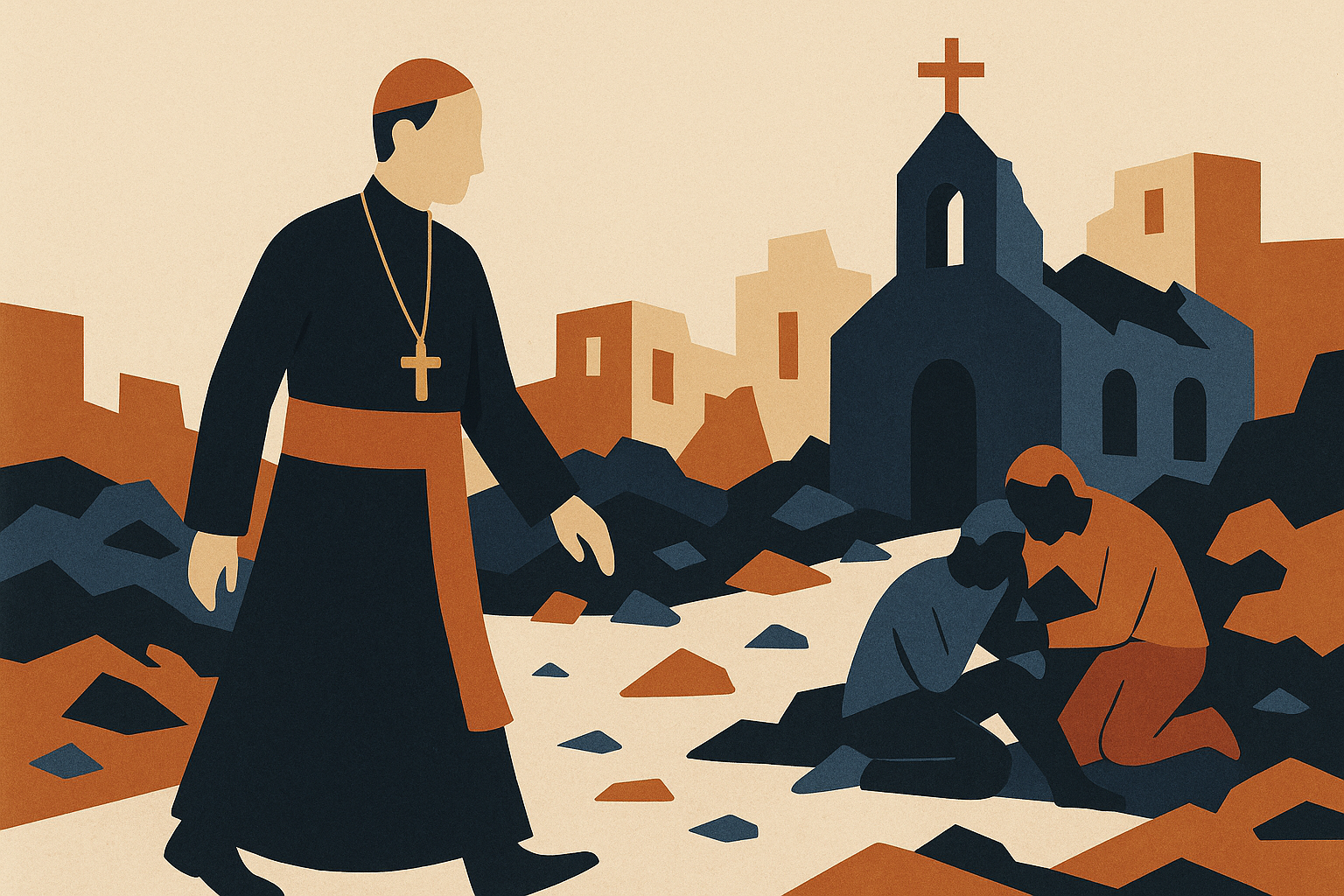
On June 22, 2026, the Latin Patriarch Pizzaballa and the Orthodox Patriarch Theophilus III traveled together to Gaza. At the parish of the Holy Family—the city's only Latin parish—the faithful welcomed them with visible joy amidst the rubble.
Context
On June 22, 2026, Archbishop Pierbattista Pizzaballa, Latin Patriarch of Jerusalem, and Theophilos III, Greek Orthodox Patriarch of Jerusalem, made a joint pastoral visit to Gaza. This is the second visit since the start of the war in October 2023. The Christian community in Gaza, which numbered around 1,000 before the fighting, has now dwindled to a few hundred: the majority have fled to Cairo, Amman, or Bethlehem.
Facts
The two patriarchs met with the clergy, religious communities, remaining Christian families, and those affected by the humanitarian crisis. At the parish of the Holy Family—the only Latin parish in Gaza, run by the Sisters of Mother Teresa—the faithful welcomed them with visible joy, according to Vatican News, "despite the state of deprivation in which they live."
The Holy See also spoke on June 24 before the UN Human Rights Council in Geneva, through Archbishop Balestrero, to demand protection for children who are victims of trafficking in conflict zones—a reality that directly affects Christian populations in the Middle East.
According to data from Aid to the Church in Need (ACN), Christians accounted for about 0.04% of Gaza's population in 2023—around 1,000 people out of 2.3 million inhabitants. Their ongoing diaspora could definitively erase a two-thousand-year-old Christian presence in the region.
Doctrinal Analysis
"I was a stranger and you welcomed me" (Mt 25:35). The pastoral visit of the patriarchs is not a symbolic gesture: it is the fulfillment of the bishop's proper vocation, which is to be with his people in darkness as in light. Saint Ignatius of Antioch, martyred in the 2nd century, wrote: "Where the bishop is, there is the Church" (Letter to the Smyrnaeans, VIII, 2).
The Church is not an NGO managing emergencies from a distance: it is a community of flesh and blood that shares the lives of its members. The physical presence in Gaza, under real danger, is an evangelical witness worth a thousand speeches.
Challenges for the Church and the Faithful
The joint visit of a Latin patriarch and an Orthodox patriarch is also a strong ecumenical sign. In shared adversity, Churches are united by what is essential: faith in Christ, closeness to the suffering, and hope.
The pastoral risk is definitive exodus. If living conditions do not improve, the last Christian families could leave, leaving Gaza without a Christian presence for the first time in two thousand years. This would be an irreparable loss for the geography of the universal Church and for the living memory of the Gospel sites.
Critical Perspective and Blind Spots
The blind spot is political: none of the parties to the conflict—Hamas, the State of Israel, or mediating powers—has proposed a specific protection status for Gaza's religious communities. Christians are the silent victims of a war that does not directly concern them but which destroys them.
The risk of the pastoral visit is also that it may be instrumentalized: some political actors exploit the Christian presence in Gaza as an argument in the conflict debate. The patriarchs took care to limit their message to the pastoral and humanitarian dimension.
To Reflect and Act
"Remember those in prison as if you were together with them in prison" (Heb 13:3). Supporting ACN, Open Doors, and the Pontifical Foundation for the Holy Land are concrete actions to ensure that the Church in Gaza does not disappear into the world's silence.
ACN is an international Catholic charity under the guidance of the Holy See, providing pastoral and humanitarian aid to persecuted Christians. In 2023, it allocated over 155 million euros to projects in 145 countries, including emergency aid in Gaza.
The Christian community in Gaza dates back to the apostolic era. In the 4th century, Gaza was an important center of monasticism, with figures like Saint Hilarion. The Crusades and the Ottoman period saw fluctuations in the Christian presence, but the community has endured until today.
Content reserved for members
Create a free account to access all our content and the weekly review.

Comments (4)
Sign in to join the discussion.

passionné_eco 25 Jun 2026 · 21:57
Deux patriarches ensemble à Gaza, c’est rare et ça fait du bien. Ça montre que l’Église ne lâche pas ses brebis, même sous les bombes.

C.M. 25 Jun 2026 · 18:13
Deux patriarches ensemble à Gaza, ça réchauffe le cœur. Même au milieu des ruines, l'Église ne lâche pas ses enfants.

J.P.R. 25 Jun 2026 · 17:01
C’est beau de les voir unis, mais franchement, on se demande ce qu’ils vont faire pour aider ceux qui restent. Des mots, c’est bien, mais du concret ?

CurioBretagne 24 Jun 2026 · 20:21
C’est bouleversant de les voir là-bas au milieu des ruines. Prions pour que cette visite apporte un peu de réconfort aux chrétiens de Gaza.