Ireland Takes Over EU Presidency: A Historic Opportunity to Reaffirm Europe’s Christian Roots
EuropeMembers only Jun 24, 20262Add to bookmarks
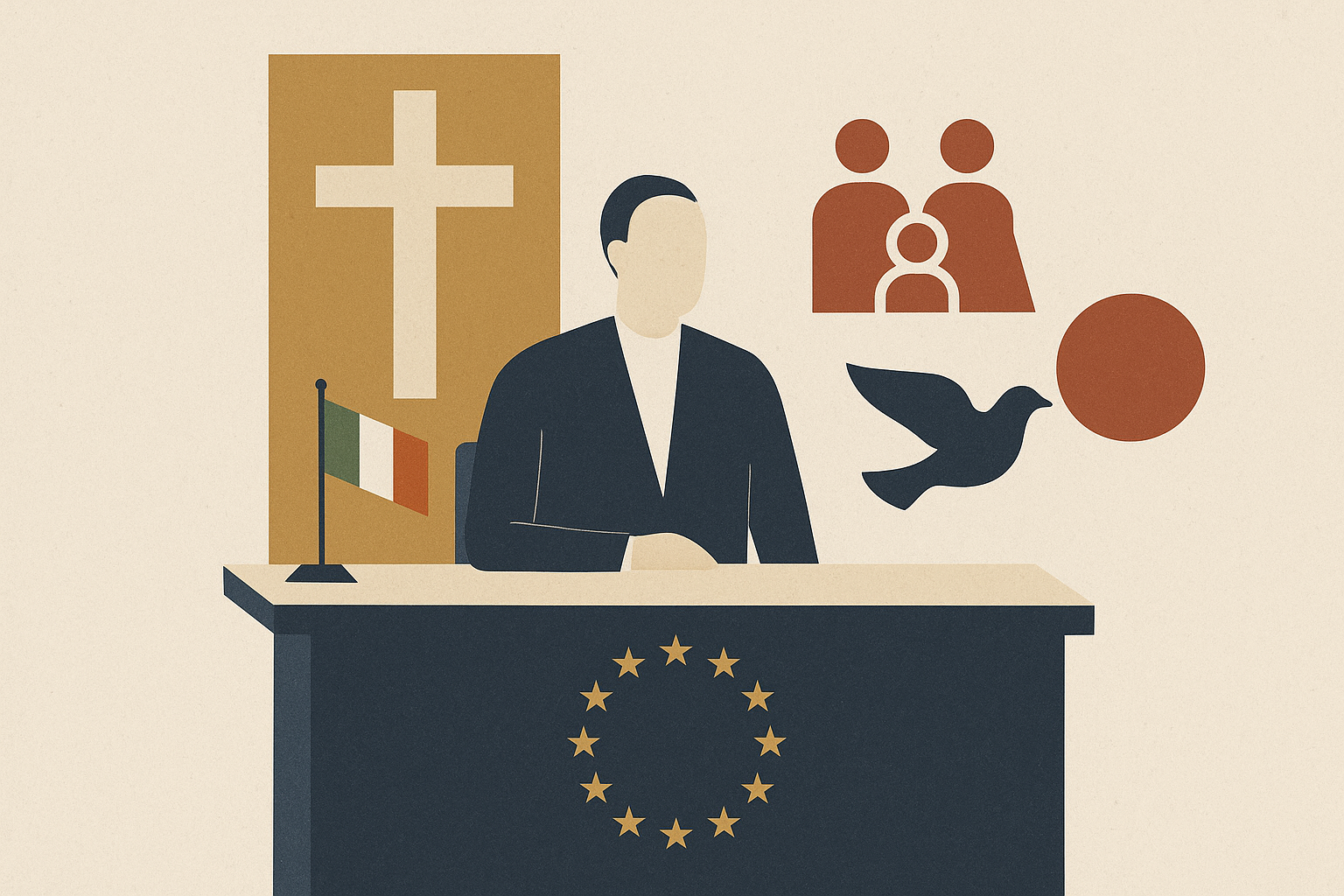
On July 1st, Ireland takes over the rotating presidency of the Council of the EU. The Irish episcopate sees this as a "unique opportunity" to remind Brussels of the Christian values that founded the European project. Yet Ireland is also the country of the referendum on same-sex marriage and abortion.
Context
We had followed the commitment of Catholic youth and the European episcopate within EU institutions. On July 1, 2026, Ireland will assume the rotating presidency of the Council of the European Union for six months. The Irish episcopate, gathered for its quarterly session, published a statement identifying this presidency as a "unique opportunity" to remind European institutions of the Christian values that founded European construction.
Facts
The Irish bishops outlined three priorities for this presidency: the protection of the natural family in EU policies, the strengthening of religious freedom in the Union's trade and diplomatic agreements, and reminding Brussels institutions that post-1945 Europe was built by men of faith—Adenauer, Schuman, De Gasperi—whose vision was explicitly Christian.
The COMECE Youth Net—a network of young delegates from EU episcopal conferences—met in Brussels from June 3 to 5, 2025, to work on Catholic presence in European institutions and issues of citizen participation, religious freedom, and European values. This network of Catholic representatives at the heart of EU bodies is operational for the Irish presidency.
Doctrinal Analysis
The idea of a Europe with Christian roots is not a slogan: it is a historical and theological thesis. Robert Schuman, declared venerable by Pope Francis on November 18, 2021, saw European construction as "a work of peace" founded on Christian fraternity. John Paul II, before the European Parliament in 1988, reminded that "Europe has a soul" and that denying it would mutilate it.
Benedict XVI, in his speech to the Bundestag (2011), affirmed that human rights themselves find their foundation in "practical reason," which cannot ignore its natural and revealed roots. Gaudium et Spes (nn. 74-76) teaches that the political common good cannot be built on an anthropological void.
Stakes for the Church and the Faithful
The Irish presidency coincides with several critical issues for Catholics: migration policy and its ethical deviations (the Taliban received in Brussels to negotiate the return of exiles), revisions of fundamental rights charters that may enshrine a "right to abortion," and the directive on cross-border healthcare.
The Irish Church will have direct access to political decision-makers for six months. The COMECE Youth Net has trained young representatives in each national delegation: this is an operational network, not merely declarative, for which the Irish presidency is an opportunity to activate its presence.
Critical Perspective and Blind Spots
The risk is institutional naivety: Brussels does not "recall" its Christian origins spontaneously. Precise legislative proposals, amendments, and coalitions with other Catholic delegations—Poland, Italy, Malta—will be needed for the Christian voice to be heard in negotiation rooms.
The blind spot is credibility: will an episcopate from a country that has erased the Christian definition of marriage and the beginning of life be heard in Brussels on these same issues? Ireland carries an internal contradiction that its opponents will not fail to exploit.
To Reflect and Act Upon
"You are the salt of the earth" (Mt 5:13). The Irish presidency is a concrete invitation: to support the COMECE Youth Net, to monitor the positions voted by Ireland in the EU Council, and to challenge Catholic MEPs so that the Church's voice is not merely that of discourse but of proposition.
Content reserved for members
Create a free account to access all our content and the weekly review.
Comments (2)
Sign in to join the discussion.

CurioBretagne 25 Jun 2026 · 21:44
L’Europe a ses racines chrétiennes, d’accord, mais elle a aussi changé. Faut-il vraiment relancer ce débat maintenant ?

passionné_eco 24 Jun 2026 · 18:38
Enfin une présidence qui ose rappeler que l’Europe, c’est d’abord des valeurs, pas que des traités et des budgets.
Story timeline
Jeunesse catholique et institutions européennes : la COMECE forme ses relais
- 1COMECE Youth Net : la jeunesse catholique face aux défis européens24/06/2026
- 2L'Irlande prend la présidence de l'UE : une occasion historique de rappeler les racines chrétiennes de l'Europe24/06/2026
- 3Le diocèse de Saint-Gall veut une "papesse" : une dérive européenne qui défie Ordinatio Sacerdotalis24/06/2026
- 4Une Europe coupée de l'Évangile se condamne elle-même : la mise en garde qui résonne26/06/2026
- 5Une Europe detachee de l'Evangile risque de "se suicider" : l'avertissement de Jean-Paul II redevient d'actualite26/06/2026