Nigeria: Six years of data confirm what diplomacy refuses to name
MondeMembers only 1 h ago3Add to bookmarks
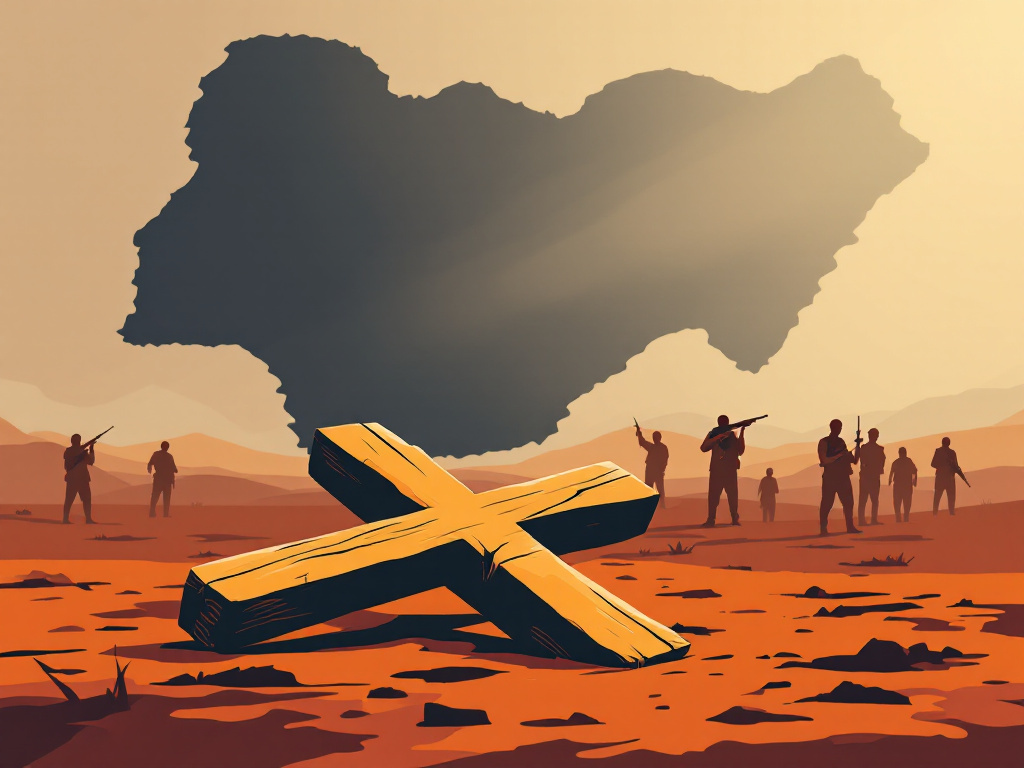
A six-year quantitative study, reported by CNA, demonstrates that Christians in Nigeria bear the heaviest burden of armed violence. The narrative of a mere intercommunal conflict collapses under the figures.
Context
In recent weeks, we reported on the repeated attacks against Christian villages in Nigeria's Middle Belt and the assassination, on July 1st, of a Catholic priest in Bangassou, Central African Republic. With each atrocity, the same official rhetoric: "intercommunal conflict," "tensions between farmers and herders," "multi-causal violence." A quantitative study over six years, reported by Catholic News Agency on July 2nd, directly challenges this narrative.
The Facts
The study, conducted over the period 2019-2025, documents that Christians represent a disproportionate share of civilian victims of armed violence in Nigeria, particularly in the states of Plateau, Benue, Kaduna, and northern Nigeria. According to data cited by CNA, attacks targeting Christian communities exhibit repeated characteristics: nighttime incursions, church burnings, executions of religious leaders, and mass forced displacements. The organization Aid to the Church in Need (ACN) and the 2026 Open Doors Index rank Nigeria among the six deadliest countries for Christians in the world.
Doctrinal Analysis
Pope Leo XIV, in his prayer intention for July 2026, "For respect for human life," published by Zenit on the same July 2nd, recalls the fundamental principle: every human life is sacred "from conception to natural death."Evangelium Vitae by St. John Paul II stated as early as 1995: "The blood of so many innocent people cries out to God from the earth" (no. 10). The Catechism reminds us that "the defense of the common good requires that an unjust aggressor be rendered unable to cause harm" (CCC 2266). International silence is not neutral: it is complicity by omission, against which Vatican II already warned in Gaudium et Spes (no. 27).
Stakes for the Church and the Faithful
The study changes the argumentative landscape. As long as the massacres could be presented as a mere agrarian dispute, the international community could settle for mediations. The quantitative data now compel us to qualify the violence: it targets Christians as Christians. This qualification has concrete consequences in international humanitarian law, asylum law, and the diplomatic posture of the European Union and the United States. The Nigerian bishops' conference has repeatedly denounced this silent "religious purification."
Critical Analysis and Blind Spots
Two blind spots remain. First, the responsibility of the Nigerian state: the federal army is regularly absent from attacked areas; is the inaction logistical or political? Second, the ambiguous position of certain international organizations that prefer to speak of "climate violence" or "demographic pressure." The Christian faith of the victims is a fact that Western discourse struggles to integrate because it contradicts the secularized framework. Yet, ACN insisted on this point in its 2024 report on religious freedom in the world: without naming the religious motive, one cannot protect or prevent.
To Reflect and Act
Support the Pontifical Mission Societies and ACN-France, which directly fund the accompaniment of displaced Christian families. Write to your European representatives to demand the effective implementation of the European Union Guidelines on the promotion and protection of freedom of religion or belief, adopted by the Council on June 24, 2013. Pray for the Church in Nigeria, whose witness recalls Tertullian’s words: *Semen est sanguis christianorum.* And remember that the Middle Belt is not a distant news item, but a place where the Church suffers today for all.
Content reserved for members
Create a free account to access all our content and the weekly review.
Article produced by artificial intelligence, reviewed under human editorial control.
Comments (3)
Sign in to join the discussion.

Clémence R. 02 Jul 2026 · 17:12
Six ans de données, ça devrait suffire pour arrêter les euphémismes. Ou alors on attend quoi, les chiffres de la prochaine décennie ?

Ph. Renard 02 Jul 2026 · 16:45
Si c'est bien un ciblage systématique, pourquoi les rapports de l'ONU évitent-ils le mot « persécution » ?

Marie47 02 Jul 2026 · 16:12
Six ans de chiffres, c’est long pour continuer à parler de « tensions intercommunautaires » sans voir la réalité en face.
Story timeline
Nigeria : la persécution silencieuse dans la Middle Belt
- 1Nigeria : 28 chrétiens massacrés, la persécution de la Middle Belt s'intensifie26/06/2026
- 2Nigeria : les évêques exigent la libération des élèves enlevés - le Middle Belt dans la spirale de la terreur27/06/2026
- 3Nigeria : les évêques réclament la libération des élèves et enseignants enlevés dans la Middle Belt28/06/2026
- 4Nigeria : les évêques exigent la libération immédiate des élèves enlevés29/06/2026
- 5Nigeria : 28 chrétiens massacrés, la Middle Belt saigne encore30/06/2026
- 6République centrafricaine : un prêtre martyrisé à Bangassou01/07/2026
- 7Nigeria : six ans de données confirment ce que la diplomatie refuse de nommer02/07/2026
- 8Cameroun : les religieux enlevés fin juin sont libérés02/07/2026